Friday, November 6, 2015

Star Wars Episode III: Revenge of the Sith

First time here? Get caught up with the mission statementEpisode IEpisode IIthe Clone Wars moviethe first season of the showthe secondthe thirdthe fourththe fifth, the sixth and the Clone Wars Legacy.


The year is 2005. Future Star Wars director JJ. Abrams gets an Emmy for Lost, everybody was plugging plastic guitars into their PS2s to master "Ace of Spades", and a strange little video site called Youtube came into being; sci-fi and fantasy dominated the box office, with now classic films like Harry Potter and the Goblet of Fire and Batman Begins, and others that haven't...really aged...all that well (I'm looking at you Spielberg's War of the Worlds and Peter Jackson's King Kong. And I'm the only person that's looked at either of you in years); and I was 14 years old. I really should just stop there, honestly. 14 is the age where looking back stops being whimsical nostalgia and just starts being constant cringing. Nonetheless, this was a big year, my friends and I all knew. This was the end of the Star Wars saga. The final film. Never to be another (so we thought). Finality was in the wind, and that wind swept up our hype like a plastic bag on the breeze. The other films be damned, they said (I didn't because you have to remember, at that point I swore by Episode I and apathetically recalled Episode II, so I liked the vitriol others so gleefully had). We were gonna embrace this. I lined up outside my local Toys R Us for the "final" midnight madness, I met up with my friends after school in the park outside and dueled with the cheapest plastic lightsabers available (which would break very easily, creating jagged edges and very real wounds, in perhaps the lamest way to get scars). It was all anyone could talk about, and when the big night came, I was lined up outside my local multiplex in full Luke on Dagobah costume (complete with plush Yoda in backpack) awaiting the midnight screening.

When the credits rolled, I remember my row of friends all freaking out, shouting and cheering. My father turned and asked me what I thought, and with a certain "Noooooooooo" still swirling around in my head, I gave an opinion I'd maintained until this rewatch: "What a piece of s**t". I'd never looked back since, never viewed it in its entirety again, avoided it on cable. Loathed it like I'd loathed no other for what I saw as such squandered potential. Of course, even then there were moments I remembered fondly, mainly the performances of Ewan McGregor and Ian McDiarmid, but those couldn't outweigh atrocities like "From my point of view, the Jedi are evil!" I get that it's meant to mirror Obi-Wan's later "from a certain point of view", but come on, it's like McGregor was going to respond with "Well, I hope you should reconsider. I have some flowcharts here..." So after 7 weeks without a prequel, spent taking in some inconsistent but entertaining stories, I was dreading taking on the only Star Wars film I ever hated.

Well, enough forbidding and loathing, let's talk about Episode III: Revenge of the Sith, shall we?


Obviously, from here on out it's gonna get pretty spoiler-heavy if you haven't seen Revenge of the Sith (or indeed any of the previous installments), so if such a thing worries you, now may be the time to turn back.

Well, I'm getting ready for a steep decline in readership moving forward for what I am about to say, but I need to say it: this is a good movie. It's not without its faults, but its a damn fine piece of entertainment all the same, and actually contains not only some of the best acting of the prequels, but one of my favorite moments of the franchise. It honestly makes me sad George didn't make a film after this, as you really see him come into his own visually, shake off the cobwebs and create some delightful and engaging scenes. McGregor is at his best, McDiarmid nails it even when hamming it up, and even the much maligned Christensen, while not as good as Matt Lanter from Clone Wars, does his damnedest with the material he's given, and hey, at least he's not as bad as that kid from Episode I, what vacuous black hole who stole all joy and momentum from any scene he was in. Nothing could be as bad as that kid...or so I thought.

Yes, there is one truly dreadful part of Revenge of the Sith, and while you can forgive Jake Lloyd for his age and simple lack of talent, this problem can only be blamed on someone's lack of giving a single solitary ****. And I mean that, I have several notes from across the film's runtime just commenting on how little of a s**t this person could be bothered to give, and those who've seen the film and aren't part of the anti-Hayden dog pile know exactly who I mean.


Look, I loved Garden State. I think she acted the hell out of Leon, the Professional, I think she nailed V For Vendetta, and I think she damn well deserved that Oscar for Black Swan. Hell, I thought she was even fine in the first two prequel films. But here it;s clear she checked out well before the cameras started rolling. Go out, rent Closer, rent My Blueberry Nights. We know she can do better than this when she cares, and perhaps some of the blame can be put on George, but at least he's trying. The same for Christensen. As rough as some of that dialogue gets, there's at least some sense of purpose, some desire to do god and failing. At 14, "phoning it in" wasn't really a phrase that had entered into my critical arsenal, but I'd heard it so often rightfully applied to Portman's performance in this film that its now become the benchmark for me, the standard by which all others are compared before I apply the label to them. However, for the first 20 minutes, before Portman takes the wind out of the sails, we're given a film that's not only good, it's exceptional.
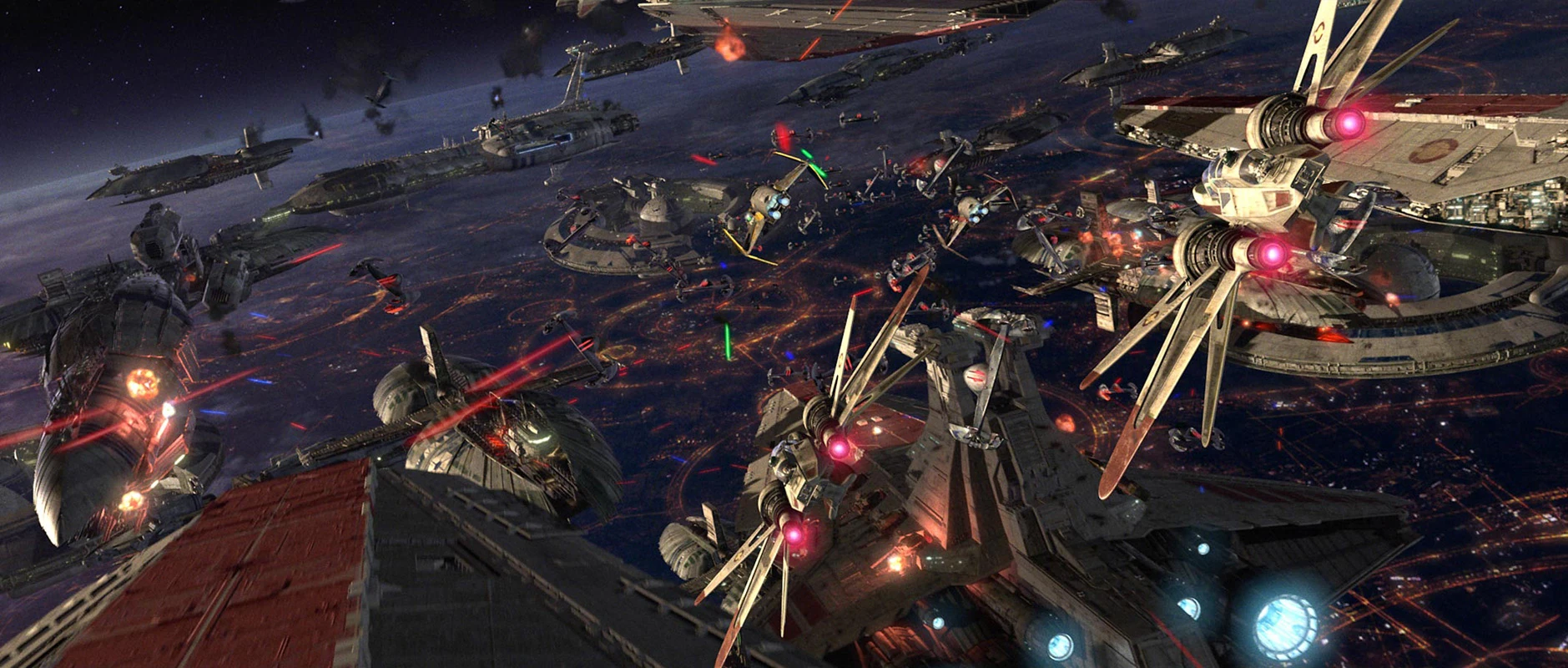

Following an opening scroll explaining that Palpatine was kidnapped by General Grievous (which makes me desperately wish that was how they wrapped up the canon Clone Wars series, the way the original non-canon Star Wars: Clone Wars did), we're treated to a thrilling space battle, with tracking shots, chaotic choreography, great banter between Anakin and Obi-Wan on their way to rescue the Chancellor. They fend off buzzdroids, they dodge vulture droid missiles, their ships skid across the docking bay of Grievous' vessel, with the Jedi leaping out and brilliantly slaying the awaiting droid army. It's exciting, it's enthralling, and when we're introduced to the gorgeously designed General Grievous, the film immediately hooks you with the kind of fanciful space operatics that so came to define the original trilogy, reminiscent of the Flash Gordon stories which inspired it. And inspired is the right word here, since this is the first time in a while Lucas feels inspired. Everything comes together here brilliantly, even the shot choices and the color seem the work of a passionate artist. When the duo finally find Palpatine, and Count Dooku (a sorely underused but excellent Christopher Lee) arrives with a swelling score, you can't help but get excited as he battles the Jedi, eventually knocking Obi-Wan unconscious, leaving Anakin to fight him alone. After being chided, we see Anakin feed into his hate, eventually besting Dooku and trapping his head between two saber blades (Dooku's and his own). Palatine, seeing his opportunity, implores Anakin to kill Dooku, but casually. Almost off-handed, regal. He knows Anakin is susceptible to the dark side, he's seen it, all he needs is the smallest push; and it works. It's a great scene and the subsequent escape scene, while a little long, as exciting and full of a fresh energy that lasts right up until they land back on Corsucant.

As they leave the ship, Obi-Wan seems surprisingly cool with Anakin killing Dooku (I know he himself killed Darth Maul, but still, shouldn't we be worried a little, since Anakin's had a lot of anger issues throughout the Clone Wars?), and they debate just how many times Anakin's saved him, including an incident on Cato Neimoidia, which of the two episodes that occurred on the planet in Clone Wars, we never see. Anakin has a brief liaison with his secret wife (who's basically reduced to a crying mess in this film, as opposed to the confident, take no s**t woman of the first two films and Clone Wars). She tells him she's pregnant, and honestly, just skip to the 1:24 mark below.


Their faces are perfect. The acting is sharp, and honest. When she reveals her pregnancy, look at Anakin, he's scared, happy, angry. He doesn't know what to feel, and she searches his face to see what not just that moment but their entire future holds. We've got six films, two TV series and an ever growing number of novels and comics, all telling fairy tales, archetypes over complex characters, but here is the closest we've ever come in any of them to honest humanity, to raw human emotion. Its a brilliant scene, and for one shining moment in this film, the two of them are believable. Sadly, it never reaches this height again, and some may attribute it to the proverbial stopped clock being right twice, but I think if nothing else this scene shows what a great film was lurking beneath all the missteps and miscasting.

Anakin becomes plagues with dreams of Padme dying in childbirth (which is the closest we get to payoff on his mom's "he can see things before they happen" stuff from Episode I), which he explains to her in a scene she's in but barely present, half-assedly delivering some of the worst dialogue in the series. Basically, from here on out, she's check out, and the film's momentum hits a snag any time we see her. Hayden handles the clunky script with a sense of purpose, to his credit, but its not enough to salvage these painful moments.

Meanwhile, Palpatine has received further emergency powers, allowing him control of the Jedi Order, and he appoints Anakin as his representative to the Jedi Council. However, while the Council concedes to allow Anakin in, they deny him the title of Master, and Christensen and Sam Jackson have a great bit of tension as Anakin petulantly disputes the decision, cut off by Windu's forceful command of "Take a seat, young Skywalker". Obi-Wan takes Anakin aside afterwards and asks him to spy on Palpatine on behalf of the council, which Anakin reluctantly agrees to (the dialogue and acting in this scene are actually exceptional). Obi-Wan departs for Utapau to hunt down General Grievous and while Yoda leaves for the Wookie planet of Kashyyk for...reasons.

Ok, there's a vague necessity to having Obi-Wan on Utapau, since Grievous needs to be dealt with (the other Separatist leaders have been moved to Mustafa on Darth Sidious' command), but Yoda's arrival on Kashyyk is utterly pointless beyond just not anting Yoda there at the temple when Anakin goes on his rampage (and a painfully forced fan-service cameo from Chewbacca, which adds a really weird layer to the next trilogy, since Han doesn't believe in the Force, yet his long-time partner straight up fought alongside a Jedi). While its nice seeing the clone trooper armor essentially become speeder bike trooper attire on Kashyyk, and there's some thrills on Utapau, its hard not to feel as though everything from Grievous' wheel-bike to Obi-Wan's weird lizard mount were all specifically and meticulously crafted to sell toys, to the detriment of a scene with too many set-pieces and not enough purpose (or in the case of Kashyyk, no purpose at all). Eventually, Obi-Wan manages to kill Grievous with a few blaster shots to the chest, which is a surprisingly simple and effective kill, considering how immortal Grievous seemed in Clone Wars. I mean, why didn't anybody try that before?

In condensing the painfully spaced out Utapau and Kashyyk sequences, however, I skipped over the best scene in the entire film. Everything from the lighting, the score, the dialogue, the acting. It's flawless, and is easily one of my favorite scenes in the entire franchise.


Palpatine, the master manipulator, convinces Anakin of a plot by the Jedi to overthrow the Republic, but then preys on Anakin's vulnerability, his fear of losing those he loves. But he doesn't do it directly. He doesn't say "Join the dark side, and I will teach you...". He tells him a story, spins a myth, and in doing so expands the Star Wars mythology, both in the literal and figurative sense. The scene contains an immense and exquisite subtlety, an artistry of writing like we've never seen from Lucas before, and for me it eclipses even the best action sequences in the film, standing out at the finest thing about the entire prequel trilogy (besides perhaps the very existence of "Duel of the Fates").

Later, when Anakin goes to Palpatine's office to tell him of the discovery of General Grievous, Palpatine much more bluntly (and with sloppier writing) reveals himself to be the Sith Lord, and Anakin fights the temptation to kill him, of once behaving in line with the Jedi principles, and goes to report Palpatine to the Council. Meanwhile, news of Grievous' defeat has reached Windu, who is determined to ensure Palpatine relinquish his emergency powers under threat of arrest. Anakin arrives in time to inform Windu of Palpatine's secret, and Windu insist Anakin stay behind lest his clouded judgement prevent the from arresting him. However, tortured by the idea that without Palpatine, Padme may die, he soon follows.

We're treated to a swift but fantastic fight when the Jedi arrive at Palpatine's office, with the Sith Lord quickly executing every Jedi besides Windu, who holds his own. Anakin arrives just as Windu has Palpatine cornered and is using his lightsaber to deflect Palpatine's own force lighting back at him, giving him that famous disfigurement. Wind is ready to kill Palpatine, who dramatically pleads for his life (McDiarmid gets really theatrical and hams it up here, but still pulls it off in my book). Anakin, once again behaving in line with the true way of the Jedi, demands that Palpatine stand trial, but Windu's rage has taken over, and he claims Palpatine is too dangerous to live. Ready to strike the death blow, Windu is stopped by Skywalker cutting off his hand, before Palpatine uses his force lightning to launch Windu from the window, killing him (while inexplicably screaming "unlimited power"). Swiftly, identifying all Jedi as enemy of the Republic, with Anakin finally in agreement, he orders all the clones to "execute Order 66", which some of you may recall from the final Fives arc of Clone Wars as being the code to deactivate the inhibitor chip in the clone brains, causing them to kill all of the Jedi. Taking Anakin in as his new Sith apprentice, and renames him, dubbing him Darth Vader.
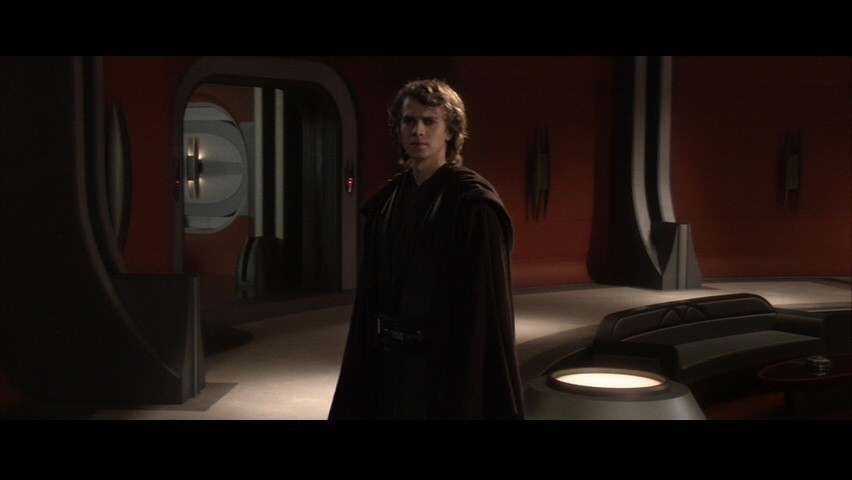

As a younger man, it always troubled me, that name. Of course, it strikes fear into everyone who grew up with the original trilogy's hearts, the Voldemort before their was a Voldemort in terms of names. But I always found it silly that Lucas gave all the other names such purpose. Sure, "vader" is the Dutch word for father, and Lucas was cleverly telegraphing The Empire Strikes Back's big twist (one of the most famous in all of cinema) in the first film, but instead of imbuing the other Sith with seemingly meaningless names, he goes out of his way to give them dark connotations. Darth Tyrannous, Darth Sidious, Darth Plagueis, Darth Maul; Tyranny, Insidious, Plague...and Maul. Why do they all get such menacing names, yet Anakin gets "Vader"? But upon this viewing, I felt like I understood, even if it took a leap of logic. If one assumes that as English is to Galactic Basic, other global languages have a parallel within the Star Wars universe, than Vader could well be the word for father, or similar sounding to it, in one of those languages, and that could be why he earned the name; essentially, it could be that Sith earn their new name based on what initially turned them to the dark side. For example, Maul was a Dathomir male, and we've seen that once the ancient magics are within them, they become animalistic, vicious. It doesn't take much of a stretch to imagine the type of massacre we see Savage Oppress exhibit to earn the admiration of Dooku in Clone Wars is similar to what feats of skill Maul demonstrated to Palpatine, and so it is his rage, his animal fury that brought him to the Sith, making Maul a fitting name. Similarly, the rich, aristocratic Dooku had aspirations to use his dark power to rule, to be a leader, to oppress the lower classes from his palaces, so his tyrannical aspirations bringing him to the dark ways earned him his title. From what we've seen of Palpatine's machinations, and what we learn in brief flickers about his past in the later canon novels (I know, I know, I'm jumping the gun a little to make my point), he's power hungry in a different way. He's Machiavellian, he's subtle, he's the snake in the grass quietly pulling strings. He's by definition insidious, and therefor earned his title thusly. It stands to reason that given Padme's death is the impetus for Anakin's desperate need for the powers of the dark side, rather than a need for power or glory, his Sith name wouldn't be one of overthrow or fear, but one of paternity.

Vader leads an assault on the Jedi temple in a truly gorgeous and all too brief sequence, with the utterly chilling scene of the children pleading with Skywalker for help before he reveals his saber blade. Meanwhile, Lucas gives us his version of the famous "Godfather Christening" as we get a montage of Jedi being mercilessly slaughtered by clone troopers, with only Obi-Wan and Yoda seemingly escaping with their lives (there may be a certain Padawan who survived too, but we won't get to him until our next installment). Bail Organa witnesses the Temple massacre firsthand, and sets out to find surviving Jedi. Obi-Wan, Organa and Yoda convene, and agree to recalibrate the emergency beacon that was calling all Jedi back to the temple to instead warn them to stay away. Vader returns to Padme, and tells her the Jedi plan to overthrow the Republic, and that he must go to Mustafa to end the war, and its right around here that the film loses all momentum.


Yes, we get one final great sequence of Vader on Mustafar, trapping all of the Separatists by shutting the doors with the Force and slaughtering them as they plead for their lives, but we then waste too much time watching the Jedi do a whodunnit over the corpses of dead Jedi children, trying to make suspenseful a reveal we already knew as we watched the massacre happen ourselves. The Jedi recalibrate the message while Palpatine calls an emergency Senate meeting to speak about the Jedi's attempted rebellion, and to declare the Republic the new Galactic Empire, which is a pretty good scene that could have been capped off brilliantly, as it has one of the best written lines in the prequels: "So this is how liberty dies...with thunderous applause", which is both topical and universal, political and proverbial, yet its unfortunately a line being delivered by Portman, who practically tosses it off while waiting for her paycheck.

There's a great moment where Obi-Wan pleads with Yoda to go after Sidious himself so that he wouldn't have to kill his former apprentice, but Yoda tells him he's not powerful enough, and the two agree to their separate fates. Obi-Wan seeks out Padme and tells her of her husband's crimes (while figuring out Anakin fathered her unborn children), and while she refuses to reveal where Anakin went, Obi-Wan knows she'll go to him, and stows away on her ship. She goes to Mustafar, and Vader, sensing Obi-Wan's presence, lashes out at her, ultimately force-choking her near-death before being interrupted by Kenobi, who for some reason stands atop the ship's ramp with his hands on his hips like 1930's Robin. Meanwhile, Yoda has tracked down Darth Sidious to his office, and after dispatching his Imperial guards with the wave of his hand like the tiny badass he is, and an awkward shot were the actor playing Mas Amedda seems to glance at a boom or something while Palpatine is talking, the classic moment occurs.

Lets face it, if you remember one part of Revenge of the Sith, this is the part you remember. The "dual duel" as it were, where Yoda and Sidious engage in over the top acrobatics through the Senate Hall while Vader and Obi-Wan battle it out amongst the magma of Mustafar. Everybody has one they prefer over the other (I prefer the Mustafar fight), but these scenes are as iconic as anything gets out of the prequels outside of Darth Maul's lightsaber, and for good reason: They're well shot, well-choreographed, and short of some painfully laughable dialogue (re: "From my point of view..."), they're utterly captivating.


Anybody who can watch the above 14 minutes and claim this movie doesn't at least have some great moments is just being an insufferable Amblin kid. Admittedly, these fights are the last high note of the film, and it screeches to a halt of "Holy s**t how much longer does this have?" after that, but damn if it isn't a fun ride getting there. Ultimately, Vader foolishly leaps toward Obi-Wan, who has the high ground (which he awkwardly states), and Obi-Wan somehow manages to cut off all three of Vader's remaining limbs (somebody please chime in in the comments or message me to explain how in the hell that could possibly work). Here, you gotta give these two credit, especially McGregor: these guys act the hell out of this scene. McGregor seems on the verge of actual tears as Hayden devolves into a creature of pure rage. It's a great scene, and Vader burning alive while Obi-Wan watches is so brutal. Quite frankly, if it weren't for the bit of pipe-laying involving the metal suit and the twins being necessary, that movie really could have stopped with Obi-Wan walking away, and it would have ended brilliantly.

But that bit of pipe-laying, setting up the original films, is necessary, that work needs to be done. However, it doesn't need to be done at a snail's pace. The much maligned birth scene deserves all of the malign. Portman is at her worst here, and it doesn't help that "dying of a broken heart" is a direction not even Meryl Streep could do anything with. That said, Padme's flicker of pain and middle-school drama class tears before immediately naming each child as sonar they're out of her is just awkward and uncomfortable, somehow being the slowest scene in history to ever feel rushed. Yes, it's great watching Vader be worked on by droids (the lighting in that sequence is stellar, and the truly inspired idea to have all of those droids move statically, almost stop-motion-esque gives the scene a great tone), but that's soon undone by the quite-frankly nauseating Frankstein pseudo-homage of Vader breaking free of his bindings to atrociously yell "Noooooooooooo!" after Palpatine tells him he killed Padme (which makes way more sense than a broken ****ing heart anyway). We're then dragged through a tedious Jedi custody battle as Organa eventually agrees to take in Leia, and Yoda decides Luke should be with his family on Tatooine because...reasons? I mean, he says the child should be with his family, but a) No, he shouldn't since Vader could find him, and b) if he should be with his family, shouldn't that mean Leia too? You're already taking one of his family away, and basically keeping her away from all her family. Why doesn't Leia need to be with her family, huh, Yoda? What kinda sexist s**t is that? Yoda also tells Obi-Wan that he shall stay on Tatooine and confer with his old master Qui-Gon to learn the ways of living after death, which is a nice piece of dialogue not just because it partly explains why Obi-Wan stayed, but also validates the final arc of Clone Wars Season 6, giving it more of a connection to the saga as a whole.

So while Vader and Palpatine watch over the construction of the Death Star, and Senator Organa asks to have C-3PO's mind wiped (but not R2) because...reasons, Obi-Wan delivers Luke to Beru on Tatooine, and Owen stands atop a familiar piece of homestead, gazing out at a familiar set of twin suns, aaaaaaaaaaaand credits wipe!


So there you have it. The prequel trilogy is concluded, the little slave boy from Tatooine is now the most feared villain in the galaxy, the Republic is now the Empire, and I'm now itching to get to the next set of films (though two more weeks to go before that). Admittedly, Revenge of the Sith isn't a perfect film, but its also not nearly as awful as people make it out to be. There's some cool action, some great performances, a good amount of world building (Quinlan Vos is even referenced by name), and certain moments like seeing the Imperials all in their uniforms give jolts and chills. It's not expertly crafted, but there are some truly inspired moments that show Lucas returning to his THX-1138 and American Graffiti form, which makes it a genuine shame we all sorta abused him out of the director's chair (though I think his heart was never really in it as it is for producing). It's easily the best of the prequels, and I'll be curious to see where it compares to, say, Return of the Jedi which doesn't really have the love the other two do outside of the fawning Amblin generation. That said, in response to is it worth watching, the answer is absolutely yes. It's genuinely a good film, mostly enjoyable, and whose faults are scene specific and mostly singular (but she's so good in other things), so as long as you have your skip button ready, the film is well worth a rewatch. As for the whole of the prequel trilogy? Even though I'd said Phantom Menace itself isn't worth your time, and I stand by it, the whole prequel trilogy is. There's enough good in these films to outweigh the bad, especially with Clone Wars existing to fill in some of the faults in the films (like explaining why the clones act on Order 66, how Qui-Gon can still be around but never appears as a force ghost, etc.). If someone offers you the chance to watch the full prequel trilogy, don't pass it up just because of Jar Jar Binks and some bad romance scenes. Overall, these films don't deserve the vitriol that's hurled at them, and indeed deserves praise for some portions. Combined with Clone Wars, its a pretty good saga so far, and the stage is set for the epic battle of good vs. evil.

We're scheduled to talk about A New Dawn next week, but I'm going to try and broaden it out and tackle everything in the canon between Revenge of the Sith and Rebels, which means three novels, some comics, some short films...its a lot of stuff, basically. I'll keep it as spoiler-free as possible, akin to how I did the Clone Wars Legacy post, as opposed to digging in deep with A New Dawn as I'd originally intended. After that, it's one season of Rebels, and then we're on to the original trilogy. We're almost at the end now, guys, but we've got miles to go before we sleep, and I look forward to hearing from you every step of the way.

Tuesday, November 3, 2015

Bonus Entry: Star Wars The Clone Wars Legacy

First time here? Get caught up with the mission statementEpisode IEpisode IIthe Clone Wars moviethe first season of the showthe secondthe thirdthe fourththe fifth and the sixth.


Hey guys, just a quick little post between posts, unscheduled, to talk about The Clone Wars Legacy. Now, this stuff doesn't much get talked about, since anything Clone Wars created post-Disney acquisition got sorta swept under the rug once it took place and they decided to focus on stories after the prequels and original trilogy (namely Rebels and Episode VII). Unfortunately, the production team had already written scripts and done early test work on Season 6 and even Season 7. The finished a short order for Season 6, as you know (we covered that in the last column), and were left with two unfinished arcs and two that were only scripted. Rather than let these fall forever in some archive somewhere to never be seen, Lucasfilm decided to create something called the Clone Wars Legacy, a subsection of the Clone Wars franchise that existed to tell these stories in whatever form they could, from hosting video on StarWars.com to adapting the scripts to comic book or novel form. So with so many unfinished stories of the Star Wars The Clone Wars universe available for us to experience (all canon), it's only right to wonder: were all these stories that bad they gave the go-ahead to finishing Jar Jar's love story?


The answer is no, emphatically no. Well, mostly emphatically no. Look, how about we just do a little blip about each, as spoiler free as possible, to let you know what's worth checking out:


Nothing like static, lifeless, PS2 graphics to move a story along, huh? Look, you can't fault the visuals for something that are essentially animatics, not intended for public consumption. The episodes A Death on Utapau, In Search of the Crystal, Crystal Crisis and The Big Bang must be judged on their writing, not their look. That sad, the stunted rough draft does hint at what could have been some beautiful visuals, and there's some really fun banter between Anakin and Obi-Wan, reminiscent of what we get in Attack of the Clones during the big Coruscant chase. The plot is honestly a little weak, but this is really a character arc, with some hilarious moments (Anakin and Obi-Wan bickering about how to properly use the force and their lightsaber at the same time) as well as some moving ones (Anakin suggesting they call Ahsoka before remembering her departure from the order, and Obi-Wan trying to comfort him). Typical of Clone Wars, the arc runs on about an episode too long, but over all it's a shame this hit the cutting room floor over honestly any of the completed arcs for Season 6, if solely because this is perhaps Matt Lanter's finest moment in a series where he really just nails it every time. Is it worth the watch? Absolutely, and if you've got ~90 minutes to spare, you can check it out here.


The Bad Batch arc is in the same boat as the Utapau arc: It's overly long by an episode, hampered by its unfinished animation, yet this is perhaps the more frustrating of the two arcs in its fate in that the introduction of the so-called Bad Batch, a group of clones born deformed with specialized skills, called in for a special assignment, is fantastic. Their personalities are instantly engaging, their quirks, including a bombshell painting of Padme on the side of their ship (much to Anakin's chagrin), utterly delightful. You're also treated to a moment of ferocious brutality from Anakin where he comes as close as ever in the series to renouncing the Jedi order, and if there's one shame in the series it was that it never showed us the further progress of Anakin's descent into the Dark Side prior to Revenge of the Sith. Is it worth watching? Definitely, and you can check it out in the same place (and around the same amount of time) as the Crystal arc (which if you're too lazy to scroll up is here).


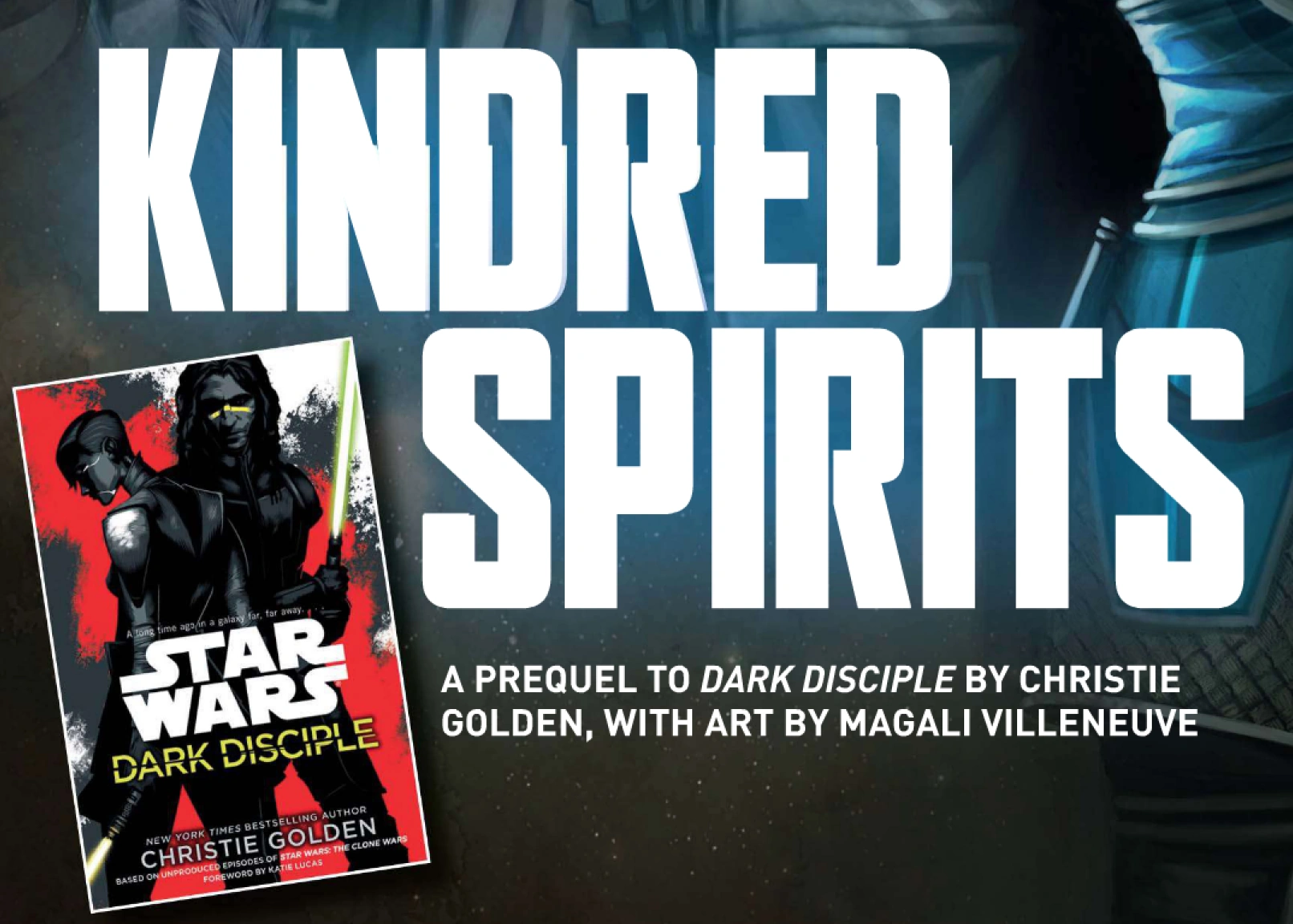
"Kindred Spirits" is a short story which appeared in Star Wars Insider Issue 159, and functioned as a prequel to the Christie Golden novel Dark Disciple. The novel was based on an eight episode arc intended for the seventh season of the series, but the preceding short is presumably an original story by Golden with follows the somewhat reformed Ventress in partnership with a pirate, battling her way out of a stand-off with a different pirate (and considering how few pirates the series had, you can guess who at least one of them is). It's an entertaining enough short story, peppered with elements that would go on to appear in the novel, and Ventress makes for a fun story in almost any scenario anyway, so the question of whether it's worth reading comes down to your particular fondness for the character. It's definitely not essential reading either way, but if you dig the character as much as I do, it's a fun little read. Otherwise, it's nothing to break your back trying to get ahold of now that the issue isn't in stores.


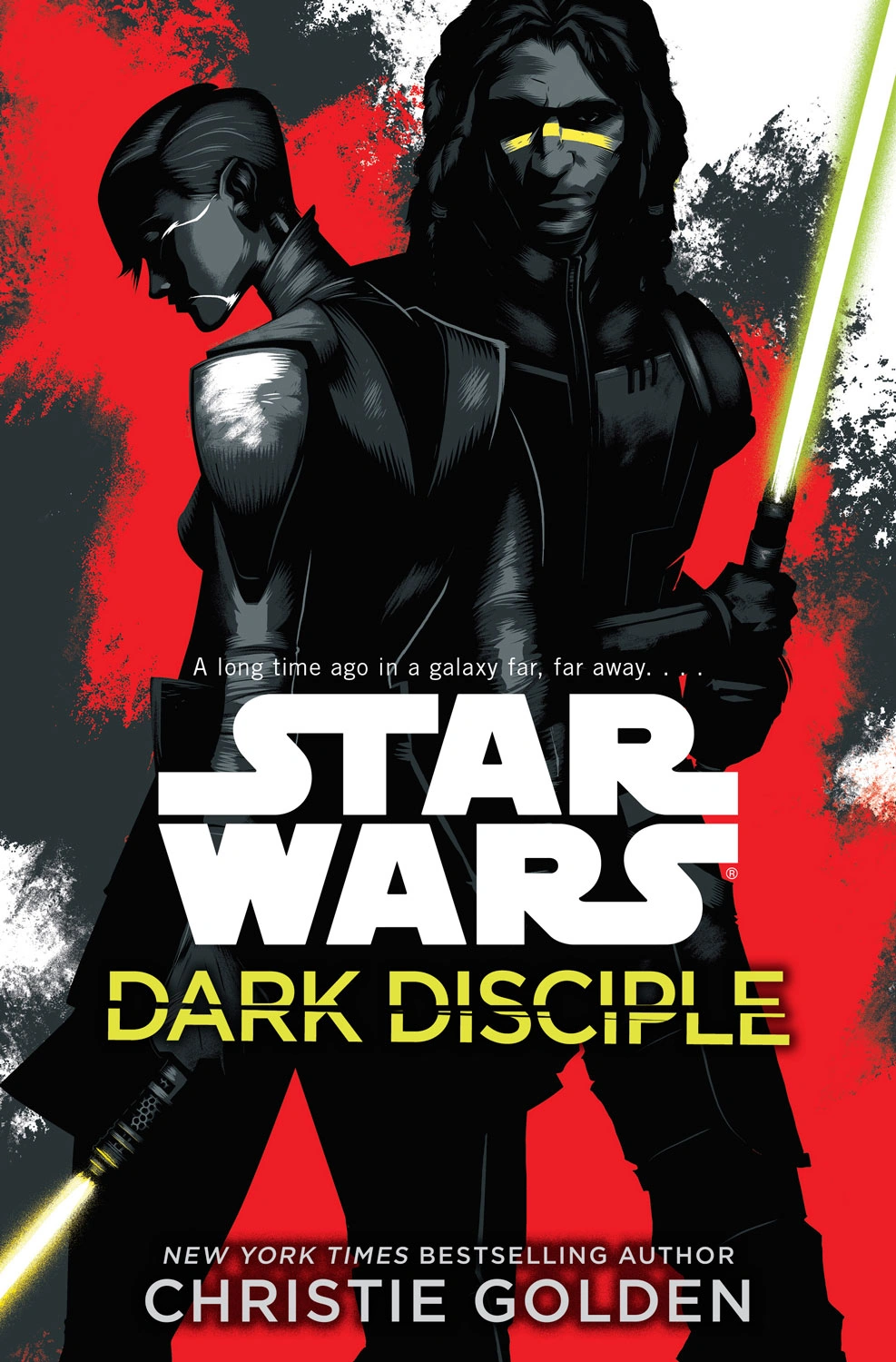
Holy crow, was this one tough to take. Now, this wasn't my first rodeo with a Star Wars novel, not even in terms of the new canon, but books like Tarkin and A New Dawn (which we'll be discussing in about two weeks time) were quick reads, done in a day or two. Dark Disciple became a chore fairly quick, and not because it's some Joycean novel of epic size or complexity. It just drops the ball with what should be an amazing premise. Asajj Ventress teaming up with Quinlan Vos to assassinate Count Dooku on the order of the Jedi Council, Ventress training voice and drawing him closer to the dark side, unwittingly playing him right into Dooku's grasp, this could have been amazing. However, its bogged down by an out of character love story for Ventress as she becomes almost a blushing schoolgirl for the cool-guy Jedi, who ultimately winds up the protagonist of the novel while Ventress gets further and further relegated to the sidelines as the book goes on. It's prose isn't abysmal, and doesn't rank so much beneath the other novels so much as its too dry to save this insufferably meandering plot. It gives some somewhat satisfying closure to Ventress' arc, but fails to stick the landing overall, and you lose interest well before that, slogging through it solely out of a sense of completion. But trust me, dear reader, I do this so you don't have to, and trust me: Just skip right past this. This isn't the kind of story you're looking for. Move along.


On the other hand, there's this. Darth Maul: Son of Dathomir, the four issue comic book series from Dark Horse Comics (the only Dark Horse comic still considered canon). This is a must read. Go out, rent it, read it, buy it. It's the first Clone Wars story in a long time with an acute sense of purpose and brevity, it does right by all the characters contained within, possesses a great sense of finality while still opening the storytellers up to new possibilities, and is ultimately the most exciting part of the entire Clone Wars Legacy (and form the quality of the writing, it's clear the crew behind it knew this too. 100% worth reading, and indeed re-reading. I intend to as soon as I'm done with this.

So that's it for the Clone Wars Legacy, mostly engaging with one swing-and-miss. Check out what you want from it, then feel free to chime in in the comments to let me know what you though. Or, you can just hang out and wait, because we're just days away from discussing the final installment of the infamous prequel trilogy, Star Wars Episode III: Revenge of the Sith, and you don't wanna miss that.

Friday, October 30, 2015

Star Wars The Clone Wars: Season 6

First time here? Get caught up with the mission statementEpisode IEpisode IIthe Clone Wars moviethe first season of the showthe secondthe thirdthe fourth and the fifth.


Well, folks, this is it. It's been a long road, getting from there to here. Been a long time, but...sorry, wrong franchise (yeah, bet you forgot that theme song ever happened). Here we are, the end of the road (sort of, there's The Clone Wars Legacy, but we'll get into that in a second), the final episodes of Clone Wars. Only 13 episodes were fully completed, and they never aired on broadcast television, instead being purchased by Netflix and put under their "Originals" banner. The season is comprised of only four story arcs, as those were all that were completed fully, with two arcs had finished and other scripted that would later be released as animatics, a comic book and a novel, all under the banner of Clone Wars Legacy, which I hope to address in another post before we get to Episode III: Revenge of the Sith. Due to both the limited episode count, and quite frankly the insubstantiality of the stories themselves, this post will be a fair bit shorter than the others, but will provide us an opportunity at the end to take a look back on the series as a whole. So without further ado, lets strap in for the conclusion of The Clone Wars.


The first arc of the series (The Unknown/Conspiracy/Fugitive/Orders) sounds like a masterwork on paper: After Tup snaps on the battlefield and shoots a Jedi point blank in the head, the Council launches an investigation into his sudden murderous rage, and Fives discovers the cause is a chip implanted in every clone's brain, which unbeknownst to him will be the cause of the Order 66 assault
that will {spoilers} eventually kill all the Jedi. Doesn't that sound awesome? It should be, and there's flickers of greatness, but the arc suffers from sub-par writing, and is far, far too drawn out, as though after years of steadily finding its footing the series fell back into the trappings of its first season. The revelation that the Kaminoans believe Darth Tyrannous (aka Count Dooku) to be a Jedi, and its under his orders that the clones are implanted with the chip to begin with is an interesting twist, though its confusing considering the Separatists, which are led by Count Dooku, would attempt to steal the Jango genes in Season 3 if the existence of a large army of clones is necessary to a plan Dooku is instrumental in. Typically, I'd go point by point through the arc, but the story drags its feet through pointless diversions and a somewhat exorbitant amount of expositional dialogue that, while occasionally building on the universe (primarily by expanding on the mythology of Sifo-Dyas, the Jedi who started the clone army, who was merely name dropped in Attack of the Clones and never outright discussed), but ultimately takes so long to get to its conclusion, an ultimately ineffectual one, that Five's death due to his wild-eyed (and justified) fear appearing to be madness to his fellow troopers who shoot him on the spot when he tries to capture Anakin and Rex is rendered cold and emotionless. The idea of clone troopers discovering plans for Order 66 or the implant in their brain early is a really engaging one, and perhaps some story in the vein of Season 1's Rookies or The Hidden Enemy, the idea of several clones in an isolated base discovering the chip, perhaps causing them to abandon the cause or even spark some existential debate on whether such an action as Order 66 is truly evil , that could have been amazing, and both seem plausible from the sharp writing and clever, deep, emotional heart of the series we've seen demonstrated time and again. Instead, the moment the Jedi themselves become strong factors in the arc, you know (if you've already seen Episode III) what you're watching will be ultimately futile, that the Jedi cannot become aware of Order 66, and therefor the whole affair will be explained away as a trifle (Palpatine claims a virus caused the clones to malfunction as they did), and will ultimately not effect the overall saga in any way at all.

On the plus side, the next arc (An Old Friend/The Rise of Clovis/Crisis at the Heart) does a lot more with its premise, and crafts a surprisingly captivating story out of banking regulations and interest rates, but once again overstays its welcome by an episode, resulting in yet another significant death losing its impact. Padme Amidala arrives on the planet Scipio to find out why the Republic hasn't been receiving its due from the Banking Clan, where Clovis, who'd previously been abandoned by Anakin to his presumed doom after he'd poisoned Padme, has been employed. Clovis takes the opportunity to tell Padme that the Clan has been committing fraud, and conspires with her to get the proof from within the Clan's vault. Though at first she rebukes him, after he saves her life during an attack by a bounty hunter, she's inclined to believe his story, and recruits her handmaiden to help. In a turn of events that results in the Clan's facilities losing power and Padme's handmaiden's death, Amidala obtains proof that the Clan has no money, and has been fooling both sides. Palme manages to get the information to Clovis before being arrested for espionage. Anakin arrives and negotiates her release, but is furious to discover Clovis is involved (I won't harp on every moment of Anakin's jealous rage in this episode, but I assure you, they're all great), almost refusing to take her with him. However, the two make a cautious reconciliation and arrive at Clovis' home to obtain the materials, only to find the place ransacked, and Clovis hiding. The three attempt to escape, but are pursued by the same bounty hunter who first made an attempt on Padme's life on the planet, and just barely escape in a ship piloted by R2.

Back on Coruscant, Clovis explains to Palpatine how the members of the Banking Clan have been embezzling funds, and therefor the monetary stock pile all the Republic's transactions have been founded on is non-existent. Palatine is cautious to believe Clovis due to his past, but when Padme takes his side, Palpatine assigns the two to investigate the conspiracy, a plan Anakin implores her not to follow, but she refuses to listen to him (and to be fair, he was being kind of a d*ck. Like, in this arc, he comes off like the kind of guy who'd use the term "friend-zone" like a girl is obligated to b**w him because he held a door open for her or something). All at once, Count Dooku and Darth Sidious conspire to get control over Clovis by helping him rise to the top of the Banking Clan, Obi-Wan mirrors the sentiment Anakin expressed to Ahsoka last season about letting emotions cloud judgement, and Padme and Clovis enjoy a nice dinner in which he explains his past. Afterwards he attempts to kiss Padme but right at that moment, wouldn't ya know it, Anakin shows up and immediately Force chokes him, and a rather intense fist-fight ensues. When Padme tries to break it up, Anakin turns to her with rage in his eyes and shouts "You don't have a say in this!" and its genuinely scary (seriously, Matt Lanter really nails it every time with this show). Eventually security arrives which breaks up the fight (Clovis attributes it to an assault, and claims Anakin was protecting them), which is followed by a surprisingly powerful and emotionally honest break-up scene between Anakin and Padme.

The Senate, after an endorsement from both Palpatine and Padme, agree to elect Clovis to the head of the Banking Clan, but unbeknownst to any, Clovis has been recruited by the Separatists (Dooku appeared to him via a hologram delivered by the droid that healed him after his fight with Anakin). It's here the story begins to fall apart, as Dooku is soon drawn personally into the mix, a battle breaks out on Scipio, and the plotting becomes both congested and incoherent, but ultimately Clovis in an act of redemption that still feels too little too late sacrifices himself for Padme's sake, and the ultimately corrupt Banking Clan is dissolved, and full control over the banks is ceded to Plapatine and the Galactic Republic. Perhaps its the financial talk that makes this hard to follow (there's not much of it besides raising interest rates, which admittedly likely lost the younger viewers, but wasn't terribly complicated. I'm honestly just trying to find the reason it came apart), or it was meant to be four episodes and was condensed poorly. Either way, the highlight of the episode is its conclusion, seeing how the Empire built up its strength and dominance through Palpatine's machinations. I just wish this otherwise thrilling arc had stuck the landing a little better.


Nope. Nope, nope, nope, nope. Look, folks, I don't get paid to do this. But even if I did, there is not enough money in the world to give this arc the minutes of my life it would take to write a synopsis of The Disappeared Part I and Part II. Even setting aside the premise, that the only representative of the Galactic Senate the planet of Bardotta will permit to help them is Jar Jar, nope. Hell, let's even set aside the reasoning behind that, that the Queen of Bardotta is in love with Jar Jar, and yes, they have "romantic" scenes together, including a kiss. This is two episodes of utter nonsense. Genuinely incoherent storytelling seemingly cobbled together from unproduced episodes of The Young Indiana Jones Chronicles and Gungan fan-fiction, that randomly incorporates Mother Talsin and Mace Windu in just a mess of plot lines and mythologizing, resulting in a set of episodes that beats out the Gulliver's Travels knock-off as the laziest writing, and is irksome even for someone who, to this day, is a Jar Jar defender. Just no, we're not doing this. Nope.


Anybody ready to get weird? Cause we're about to get real weird. After the lightsaber of Sifo-Dyas is discovered on a desolate planet, the Jedi Council launch an investigation into his death. Though records say he died on Felucia, the details of his mission there have been sealed by the office of the Supreme Chancellor. When questioned by Yoda, Palpatine reveals the records were sealed when he was a Senator, on the orders of then Chancellor Valorum, who informs Yoda that he did indeed send Sifo-Dyas on the mission with his assistant Silman. Anakin and Obi-Wan arrive on Felucia and find Silman, but Count Dooku also lands on Felucia and executes Silman with a Force choke before he can provide the Jedi any information. In the ensuing battle between the Jedi and Dooku, they discover  that Dooku is also Darth Tyranus, and that Tyranus was the one who convinced Sifo to assemble the clone army in the first place, meaning the entire Republic army was created by their greatest enemy. Back on Coruscant, Yoda reluctantly accepts that Dooku is merely a puppet of the Dark Lord of the Sith, as they all are.

During his meditation, Yoda hears the voice of Qui-Gon Jinn (once again, Liam Neeson is back to do the voice), but the other Jedi don't believe him. They treat him to a battery of tests, but Yoda eventually breaks free (with the help of Anakin) and arrives at Dagobah, as instructed by Qui-Gon. Once there, Jinn explains that he had partially learned how to preserve his spirit after death, and that Yoda can learn the technique properly. Yoda wishes to know the identity of the Sith Lord, and is treated to visions of all that is to come. Qui-Gob encourages Yoda to seek out the Origin of All-Life, where he can begin the next stage of his journey towards ultimate knowledge.

Now here's where it starts to get wacky. Yoda arrives at the planet which is likely the Origin of All-Life, where he is set upon by five spirits, each with a mask of an emotion which reflects their demeanor (think the villainess from Reboot) who offer to put him through a series of tests to train him, as he himself will one day train someone great. They tell him his first test will be overcoming his fear, which he claims he has. However, he is confronted by his dark side, a shadow manifestation that appears like a mix of Gizmo from Gremlins and the final villain of Zelda II, and no matter how much Yoda denies him, he only grows stronger. It's only when Yoda acknowledges the darkness within him that the visage disappears. Afterwards, he's treated to two visions, one of all those he cared about slaughtered, including Ahsoka Tano, who reminds him how he cast her out. Another where the Clone Wars never occurred, and Dooku is still his pupil. When Yoda rejects the latter vision, recognizing it was false, it dissipates, along with the spirits, who tell him he has a final challenge to face on Moraband.

Count Dooku is called to Coruscant by Darth Sidious, while Yoda wards off the spirits of dead Sith on Moraband on his journey for truth. He's confronted by the spirit of Darth Bane, the originator of the Rule of Two, but is unafraid, and therefor dismisses the visage as the illusion it is, and proceeds into the Sith Temple for his final test. Just then, Sidious uses Dooku's blood and their collective Force lightning and...things get weird. Like, really weird. Like that amphetamine episode of Mad Men weird. Yoda is in a vision where he has to attack Dooku and Sidious, but Anakin beheads Dooku, and Yoda and Sidious fall off a cliff, but Sidious is just a robe...yeah, it goes there. Yoda awakes, proving he's stronger than Sidious anticipated, and one of the spirits tells him he will learn to retain his spirit after death, and is treated to a vision of the future, even hearing his eventual last words "There is Another Skywalker". Back on Coruscant, Yoda tells Obi-Wan and Mace Windu that the Clone Wars is a lost cause, but that there is another way to ultimately win the war for the fate of the Force.


I can see why the showrunners felt that was a better ending for the series. Indeed, it hints at the original trilogy, ending on as positive a note as it can within its restraints, and putting a neat little bow on the series. However, for my money, the conclusion of Season 5, bleak and ambiguous, leaving Anakin distraught and the Jedi Order in disarray after expelling one of their own unjustly, forms a much better bridge to what's to come (Revenge of the Sith, which depicts the rise of the Empire and Anakin's fall). This season reveals a lot of what's to come to its characters, from the chip implanted in the clones to Yoda's visions of what's to come and his assurance that the war is futile, that it almost ruins the prequels in a way the rest of the series had otherwise redeemed them. Instead of showing how much more three-dimensional and intelligent these characters were than what we saw in the previous two films, this season makes them look either negligent or ignorant for ignoring all that has come to light and allowing Order 66 and the rise of the Empire to occur. Wise Jedi like Yoda and Obi-Wan, who without this season were blindsided when the troopers turn in Episode III are now to blame for merely accepting Palpatine's excuse about a parasite and never looking further into these chips. Indeed, everything that transpires in Revenge of the Sith is partly Yoda's fault. Sure, he never found out who the Sith Lord was, but he had plenty of visions of other things, including vivid visions of Order 66, and yet allows it to occur ion favor of some "grander plan" that occurs to him. But if the Clone Wars is hopeless, like he concludes, why keep fighting it? Why continue to let lives be lost in a ruse?

So, for the last time for this series, we ask, is it worth watching? As for Season 6, I have to say no. There are some interesting ideas, but they're mostly squandered by unnecessary revelations to characters who seemingly forget them in the next installment of the saga, and sub-par writing that feels rushed and devoid of some of the humanity imbued in previous seasons. The Clovis arc is the highlight, and the Yoda story has some interesting additions to the mythology that are fun for the curious, but the show really takes a step back from where it had gotten to in terms of overall quality.

However, as for the series as a whole, there's no question its worth watching. Sure, there are some rough patches, but The Clone Wars is on par with, say Led Zepplin's discography. Is there some bad stuff in there? Sure, there are some real rough patches (Jar Jar's love story is the equivalent of "Candy Store Rock"), but when its good, it's really, really ****ing good. From Rookies and The Hidden Enemy to the Umbaran and Mortis arcs, there's some absolutely amazing, thrilling stories in here, and just like you wouldn't want to deprive someone of "Black Dog" or "Stairway to Heaven" just because Presence kinda sucks, you don't want to miss out on some of the most exciting Star Wars stories in decades just because you hit a few patches of average. For those who have been watching along with us, I'll see you next week for Episode III: Revenge of the Sith (if I don't see you sooner for something extra). For those who have been waiting to see if the series is worth the time, I implore you, dig in and enjoy; you're in for one hell of a ride.

Oh, and that "something special" I mentioned? Keep checking, cause even though its not on the schedule, just maybe I'll have time before Episode III to dig into the Clone Wars Legacy. Here's a little taste:

Friday, October 23, 2015

Star Wars The Clone Wars: Season 5

First time here? Get caught up with the mission statementEpisode IEpisode IIthe Clone Wars moviethe first season of the show, the second, the third and the fourth.


Well, here it is. The final season to air on broadcast television, the last season to have completed production on all its episodes, and some could say the last "real" season, since Season 6 is regarded as "The Lost Missions" whose finished episodes were relegated to Netflix while several unfinished works popped up elsewhere online. Indeed, the finale of Season 5 feels like a series finale, there's a sense of gravity and finality to it that I question whether additional episodes were even necessary, or whether they might diminish the impact of such a powerful final moment. And it's that sublime swan song for a certain character, and the shadow it casts in both directions, that encapsulates what makes assessing Season 5 so confounding.

Swan song for a certain character? Does such a succinct sentiment suggest spoilerific subsequent sentences (Forgive the alteration, I've been reading a lot of those early Lee/Kirby books as of late, and that stuff sticks in your brain)? Yes, even though its been a while since I've tossed up the spoiler tag, this season really does have a huge, game-changing twist that could ruin some of the fun of the series and everything moving forward if you know it, so turn back now, true believers, lest your fun be foiled.

Ever since I undertook this project people have been telling me "Season 5 is the best". Anyone I knew who watched Clone Wars, anyone I met who wanted to talk about it, they all said the same thing. Season 5 was the peak, the pinnacle, the crowning achievement its all been building towards, and after finishing it, I'm inclined to agree with them. My instant reaction when it finally ended was a series of "wows" and gushing commentary on its cinematic nature, stellar visuals and sharp writing. But unlike those that championed the season to me, I have notes. Real-time notes charting my progression through the season and my opinion of it as such, and they hardly echo my final feelings. While the season never dips as low as the two-parter last season with 3PO and R2, its clear the final two arcs of the fifth season over-shadow an otherwise average collection of episodes, and its clear they knew that as well, transplanting what should have been the first episode of the penultimate arc to the beginning of the season, as though to assure the viewer if they just make it through the rough patches, the best is yet to come (strangely, the DVD release of the season replaces the episode in its initial placement at the start of the penultimate arc).

But lets not waste any more time fretting about episode orders and dive right into the episodes themselves, shall we?


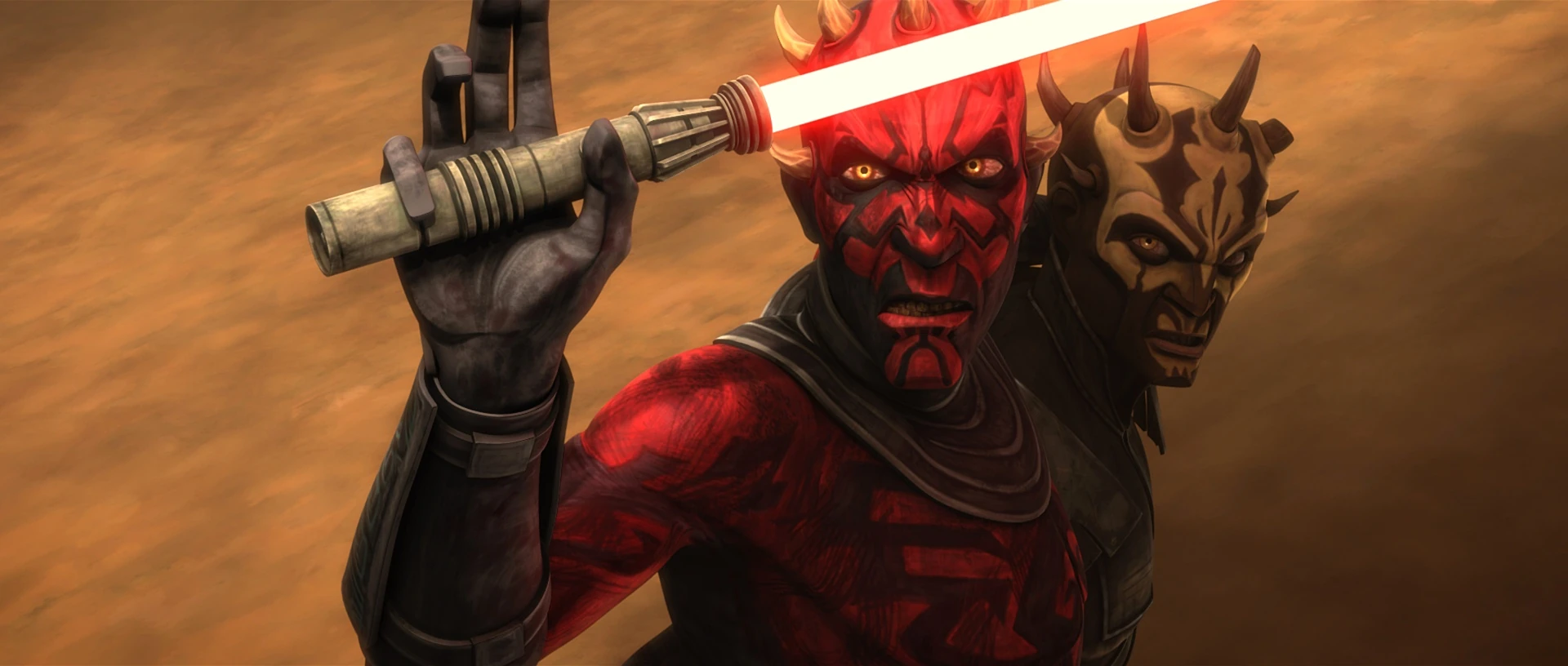
As stated above, Revival is actually the first episode of a much later arc, but its a hell of a way to kick off the series. It makes sense, after all. You finish up last season with the reunited Dathomirian brothers, it would be a bit rough to have to wait the majority of a season to see them again. We start out seeing the Sith duo robbing a space station, like a lightsaber wielding Butch and Sundance. Maul, now refusing to call Savage his brother anything but apprentice as "there can only be two Sith, a master and an apprentice", recruits a small group of Hondo's pirates and when Hondo himself refuses to aid them, make plans to attack Hondo's base on Florrum. Obi-Wan and Adi Gallia make their way to the robbed space station and are directed themselves towards Florrum. The Jedi manage to reach Hondo, and they agree to work together to fight off the Sith. When the sith arrive, Obi-Wan takes on Maul while Gallia challenges Opress. Unfortunately, he proves to be far too powerful for her, running her through with his horns before piercing her body with his blade in an even at this stage shockingly brutal murder. After a brief retreat, Kenobi instructs Hondo to allow the Jedi to pursue the Sith brothers alone, and to blow the section of the tunnel they enter, so that they might be alone.

In a rather epic bout, Obi-Wan takes on Maul and Opress wielding both his and Gallia's lightsabers, finally managing to sever Savage's arm. The brother retreat outside, only to face a full on assault from all of Hondo's men, the initially traitorous of whom have been reaccepted into the group after they realized the Sith have no sense of loyalty. Maul's leg is damaged in the shoot-out, and though they manage to reach their ship, one of the engines is damaged in flight, and they're forced into an escape craft as the ship crash lands on the planet. Honda and Obi-Wan search the crash and find no sign of the duo. Honda tries to assure Obi-Wan that they simply disintegrated in the crash, but Obi-Wan leaves the planet with trepidation. In a meeting with Chancellor Palpatine, Yoda and the Chancellor agree that Obi-Wan should forget about Maul, that its a personal matter, and he should instead focus on the larger Separatist threat, with Palpatine assuring Kenobi should the Sith brothers rise again, they can handle it. Of course, when the two Jedi depart, Palpatine bridges his hands and casts an ominous, knowing smile.

Epic is the only way to describe this arc (War on Two Fronts/Front Runners/The Soft War/Tipping Points). Ok, more accurately, epic with a slight hint of discomfort, but the show's writers can hardly be blamed for that. They were just...awkwardly prescient. How? Well, they called a city Isis. Now, that's not awkward in itself. Everyone from Archer to Wonder Woman has used that name in some form or another, its just now been co-opted by an evil, vile organization. It's like seeing a swastika on a Kipling book from 1914. So we begin the arc with Anakin, Yoda, Mace Windu and Obi-Wan discussing whether to arm and train rebels to overthrow Isis, or whether doing so would mean they'd be arming terrorists and creating more problems in the region. I'm just gonna, just gonna repeat that last sentence. On September 21st, 2012, we had a show discussing whether to arm and train rebels to overthrow Isis, or whether doing so would mean they'd be arming terrorists and creating more problems in the region, and it was The Clone Wars. So everything that transpires over the next four episodes has an overtone of discomfort, as it hits astoundingly close to home in a modern context. The Jedi council relents, knowing that if they themselves can't take out the region's corrupt leader (which could disrupt many political alliances they have), they have to risk the possibilities of creating a terrorist cell by arming and training rebels to rise up against the leader in Liby....I mean, Onderon.

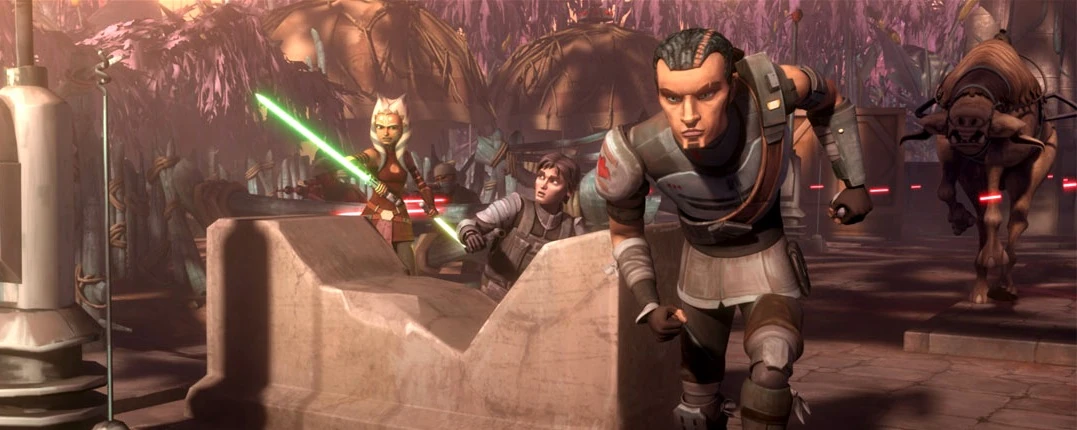
So Anakin, Ahsoka Obi-Wan and Commander Rex head to Onderon, and begin to train the rebels, led by brother and sister Steela and Saw Gerrera and, to Ahsoka's surprise, Lux Bonteri who to her even greater surprise has romantic tension with Steela. The group train the rebels in both strategy and subterfuge, explaining that a slow-rolled grenade can penetrate a destroyer droid's shield where projectiles can not, and improving their marksmanship. This comes in handy when a swarm of battledroids falls upon the camp, and the group manages to take out a tank. Realizing they have little time to lose, they sneak into the city of Isis disguised as merchants and forage for supplies, prepping for an assault.

The rebels launch a series of attacks on the droid forces in the city, endeavoring to avoid civilian casualties, but their efforts are still met with caution and fear from the public. The planet's new king, Sanjay Rash, brings forth his deposed predecessor Ramsis and accuses him of creating this rebellion, which Ramsis denies as he'd been imprisoned, and informs Sanjay that it is the people themselves who are rising up. Meanwhile, the Jedi decide the rebels have to earn the public's trust, and therefor must act on their own. Leaving only Ahsoka behind as an advisor, Anakin, Obi-Wan and Rex depart, but not before Anakin reminds Ahsoka not to get distracted, implying her unspoken feelings for Lux will cloud her judgement (we needn't harp much on the hypocrisy there, as I'm sure its apparent to all). The rebels utilize a tank to destroy the city's power generator and begin to stealthily take out every droid they can find. Regrouping, they realize they need a public face to unite the citizenry behind, especially since Count Dooku will seek retribution for the destruction of his army. Much to Saw's dismay, the group unanimously elects Steela.

Feeling Rash has failed, Dooku sends his droid general Kalani to fight back the rebels. In a move of desperation, Rash and Kalani determine they must promptly and publicly execute Ramsis in order to dissuade the public rage. The rebels get word of the execution, and while Steela makes plans to rescue the king direct from the gallows, as it were, Saw goes rogue and attempts to rescue the king that night, only to be captured and tortured himself. When word gets back to the rebels, the group want to launch a rescue, but Steela and Ahsoka, the latter of whom is wrestling with her duty to her superiors and her compassion for the rebels, advise them to wait, as rescuing the king is the priority. They manage to halt the execution with help from the Onderon army, who seeing their leader upon the chopping block decide to rise up as well, and they manage to escape when the public starts a riot. Realizing they need unanimous public support, expecting a large scale Separatist attack, Ramsis creates a holo-transmission broadcast to the entire planet rallying them to battle. Meanwhile, Ahsoka must report to the Council that her participation in the rebellion is public knowledge.

With a massive assault on the horizon, Ramsis promotes Steela to general of his full forces while Ahsoka pleads with the Jedi for back-up. Though they refuse, Anakin, further disappointed in the Jedi's inability to enact change, hires Hondo and his band of pirates to deliver rocket launchers to the rebels. With the weapons, the rebels fight back the droid army, but in a stunningly gorgeous sequence,  Steela hangs for her life from a cliff and Lux, running to save her, falls. Ashoka manages to use the force to save Lux, she is wounded by a droid canon before she can save Steela, causing her to fall to her death. In the end, the droid army is defeated, the people take back Onderon, and Lux decides to follow in his mother Mina and represent Onderon in the Senate, bringing it back to the Republic.

Though Revival was a more exciting single episode, this rebellion arc was a hell of a way to kick off the season, drawing influence from everything from Munich to Lawrence of Arabia. Enjoy it, hell, rewatch it. Get your fill. Cause its about to get real slow after this.


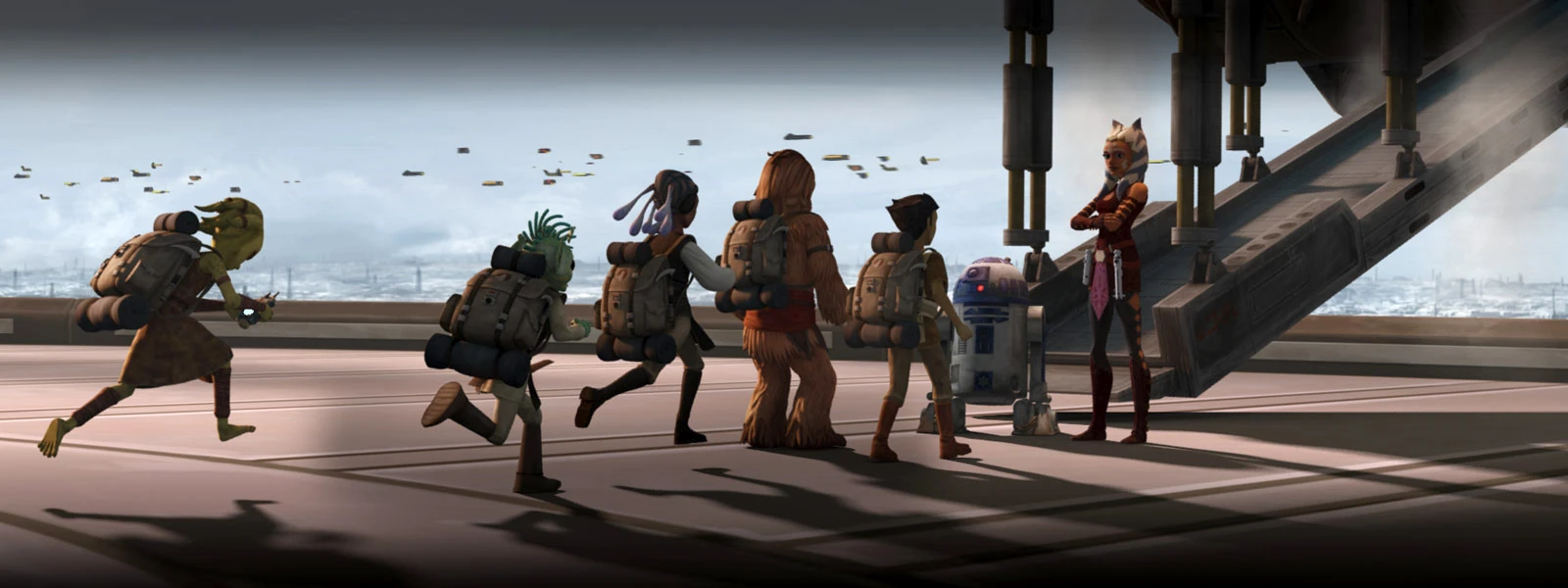
This is four painfully long episodes about Padawan finding their lightsaber crystals and tangling with pirates (The Gathering/A Test of Strength/Bound for Rescue/A Necessary Bond), whose one saving grace is David Tennant (everyone's favorite Doctor on Doctor Who and everyone's nightmare on Jessica Jones) as a droid who works with the Padawan. Really, though, this is where this season hits perhaps the worst drag of any (save R2 and 3-PO doing Gulliver's Travels). If anyone wants a synopsis, much as I hate to sacrifice my sense of duty and professionalism, they'd be best off heading here, as I've honestly forgotten everything short of the first Scottish Doctor, and I have even less to say about it.


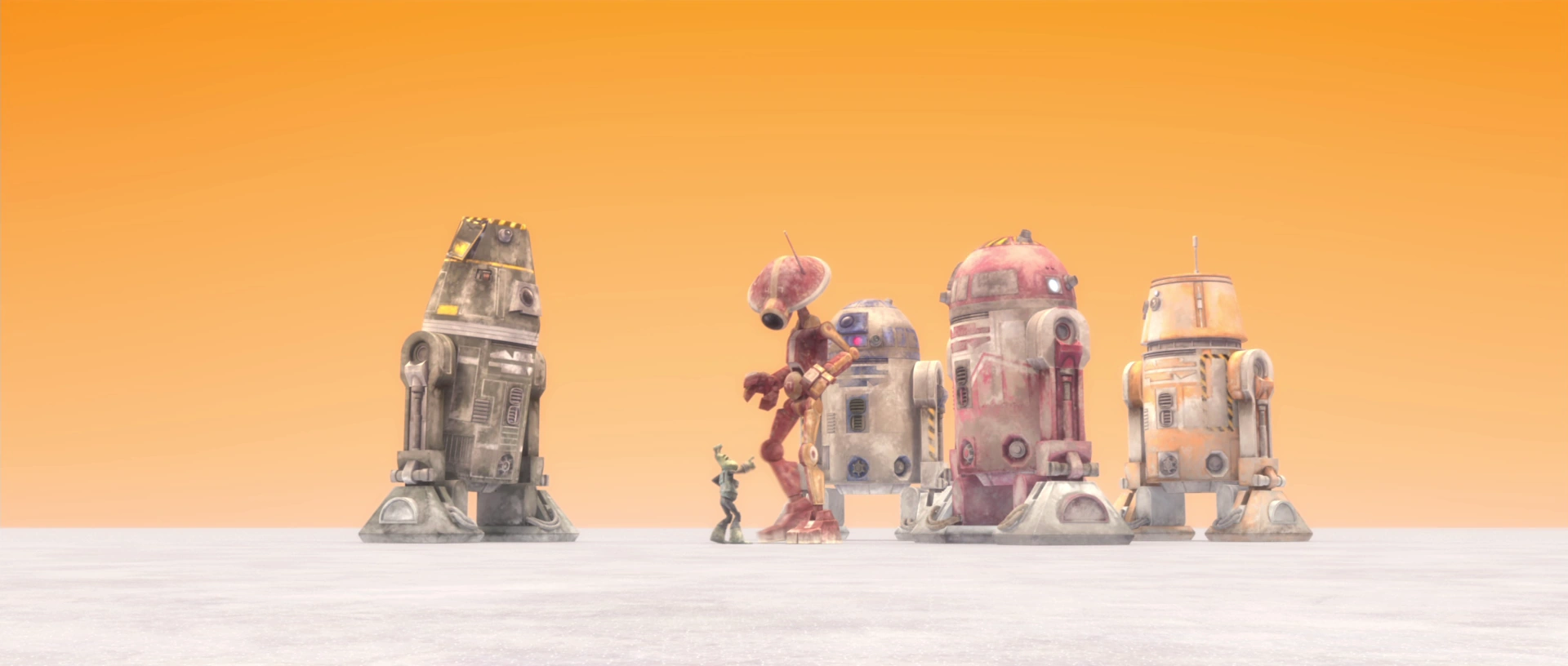
Oh boy. So, in a quadrilogy of episodes (Secret Weapons/A Sunny Day in the Void/Missing in Action/Point of No Return), there's only one that's worthwhile in the batch. Now, these episodes aren't as forgettable as the previous arc, but they're pretty unremarkable. A team of droids are put together by the Republic, almost all of whom are astromech, but they throw in a bumbling, sassy pit droid and a tiny alien general because who would watch a whole story about robots who can't talk, right? In Secret Weapons, the droids infiltrate a ship and steal an encryption device. It's a cute little story that could have ended there, but they drag it out for three more somewhat grueling episodes where they get stranded on an empty planet, stumble upon an amnesiac Clone Trooper named Gregor (in the one good episode, that packs an emotional punch as Gregor, finally understanding his purpose, sacrifices himself so that the droids and their general may flee) and finally prevent a Jedi cruiser loaded with explosives from crashing into a Republic meeting. There's a lot of potential in each one of these stories, but other than Missing in Action its squandered by a disinteresting cast, sub-par writing and a lack of purpose.


Well, after two underwhelming arcs, we return to what kicked things off (Eminence/Shades of Reason/The Lawless). Maul and Opress' escape pod is intercepted by the Death Watch, who take the brothers aboard their ship in order to interrogate them. After providing the two Sith with new limbs, Maul regains consciousness and explains that it was Obi-Wan Kenobi who put them in their current position, peaking Death Watch leader Pre Vizsla's interest. Vizsla explains to Maul the current situation on Mandalore, and how its also the fault of Kenobi, and the two agree to form an alliance, each with the intent to betray the other when the opportunity is right. Maul advises Vizsla that they will need reinforcements, and they seek out the Black Sun crime syndicate. Though Ziton Moj is willing to join, the Black Sun council refuses, resulting in Savage throwing his lightsaber down the long table, beheading them all in one fell swoop (perhaps the coolest moment in the entire series thus far), leaving Moj the sole leader, and he naturally offers the Black Sun's resources to the group. After also recruiting the Pyke Syndicate, the army makes their way to the Hutt council and attempt to recruit them. Instead, Jabba sets his bounty hunters on them, leading to a long and exhilarating firefight, ultimately resulting (after some Hutt murder and a trip to Tatooine) in the Hutts offering their allegiance to the Shadow Collective as well.

Maul initiates a plan to have their army commit criminal acts throughout the city, making the current administration look weak and allowing the Death Watch to swoop in as "heroes" to stop it. They do, and quickly depose Duchess Satine, with public support. When Maul suggests they spread their conquering to the Council of Neutral Systems, Vizsla refuses, saying Mandalore is enough. Enraged, Maul and Opress seek someone to act as a figurehead, and find former Prime Minister Almec imprisoned next to Satine. Freeing him, Maul finds Vizsla and challenges him to a duel, and the bout between dark saber and lightsaber is thriving piece of combat, resulting in Maul's victory, and Vizsla's submission to his own execution (by his own blade, no less). As Maul claims control over Mandalore, Bo Katan (the fantastic Katee Sackhoff again) and several other Death Watch members refuse to kneel before him and instead flee. Maul instates Almec as leader of Mandalore, and Almec presents himself before the people and declares that Satine killed Vizsla, turning the public even more against her.

Satine is broken out of her cell by her nephew Korkie and members of the Death Watch, including Bo Katan (who, in a genuinely surprising twist, is Satine's sister). They flee, pursued by Mandalorian soldiers, and Satine manages to send a message to the Jedi temple before being recaptured. Yoda refuses to help without the Senate's permission, but Obi-Wan disregards this, donning Rako Hardeen's armor and taking Anakin's ship to Mandalore, where he steals a commando's armor and heads to Satine's holding cell, escorting her out and onto an elevator, when another Mandalorian enters. There's an incredible moment of tension before the other soldier inquires about Obi-Wan's authorization code. Their cover blown, Obi-Wan knocks the soldier out, and they two flee, pursued by several Mandalorians and eventually Maul, so destroy Anakin's ship before they can get away. In his chambers, Maul proceeds to force-choke Satine in front of Obi-Wan to torment him, chiding him to give in to his hatred. When Obi-Wan refuses, Maul pulls Satine forward onto Vizsla's darksaber, killing her. Here, in a beautifully brutal moment, the pain in Obi-Wan's face is enough to elicit tears, and in a wide shot, we see him cradle her in his arms, as she tells him "Remember my dear, I loved you always. I always will" it's so operatic, one can almost hear the finale of La Boheme play beneath it. As Maul's soldiers bring Obi-Wan to the prison below, he's rescued by Bo Katan and her men, who get him safely to a ship and implore him to alert the Republic to the situation on Mandalore, risking a Republic invasion that Maul may die, certain that Mandalore will survive. Meanwhile, Palpatine himself arrives on Mandalore in the guise of Darth Sidious (or Darth Sidious finally removes his disguise of Palpatine, whichever you prefer). Words cannot do justice to the glorious, insane fight that ensues between the two brothers and the Sith master, and thankfully, I don't have to:


Yeah, that happens. That ****ing happens. And it is glorious. That's also, how the episode ends, so its a hell of a cliffhanger (one that's apparently resolved in the Darth Maul: Son of Dathomir comics from Dark Horse that appear to still be canon, according to Wookiepedia, and as such I'll endeavor to cover them within the timeline if possible). This is quite possibly the rewatch arc of the season, for its seemingly endless memorable moments, though the final arc may take the title.


This is a four episode arc (Sabotage/The Jedi Who Knew Too Much/To Catch A Jedi/The Wrong Jedi) that doesn't pack a whole lot in like the last one does, opting instead for one simple, singular story, but manages to avoid the trap most of the series falls into of being too long, wasting episodes, etc. Someone has bombed the Jedi temple, and Anakin and Ahsoka look into it, though it appears as though a Jedi was behind it. What follows is a brilliant blend of CSI, Homeland, Hitchcock and a very obvious nod to The Fugitive, and stands as perhaps the best piece of straight up storytelling the series has done thus far, as well as being the closest thing to a "game-changer" the show has ever done. Given that Anakin and Ahsoka were off-world at the time of the blast, they're entrusted with investigating the blast, and find a suspect in Jackar Bowmani, a janitor who died in the explosion. Interrogating his widow, she insists her husband could not have done it, that he was a good man who worked hard to get a job at the Jedi temple (which is weird the Jedi, being a militant and insular organization with many enemies and a strong sense of discipline, would hire outside maintenance help rather than function more like a monastery. With negligent hiring practices like that, they're practically begging for things like this to happen). Upon examining what remains of Jackar, his hand, they find nano-droids in his bloodstream, indicating that he didn't plant a bomb so much as he himself was one. The two Jedi search Jackar's home and find more nano-droids, as well as Jackar's widow, Letta. They attempt to bring her back to the temple, but she flees. When they track her down, Anakin is in a rage, and his anger frightens her into a confession, at which point she is arrested.

At the funeral for the Jedi killed in the explosion, Ahsoka notices her friend Barriss Offee is grieving, and discovers one of Barriss' friends was lost in the explosion. Determined to see Letta suffer for her crimes, Ahsoka is frustrated to find out that Admiral Tarkin will be undertaking the trial, wishing Letta had been left in Jedi custody, and expressing her desire to see her punished. Though Ahsoka leaves to comfort Barriss, Tarkin soon calls her back, saying Letta wanted to speak to her, and refused to confess to anyone else. However, one the two are alone in Letta's cell, she reveals to Ahsoka that she was put up to the bombing by a Jedi who was dissatisfied with the Council's current role as pawns for the Republic. However, before she can say more, she is force choked to death in the cell, and though Ahsoka raises her hands in panic, to all observers it appears she herself is doing it. Ashoka is promptly placed under arrest and quarantine by Tarkin, who even tauntingly replays the security footage to Tano to try and force a confession from her. Anakin tries to visit his Palawan, but he is refused entry. Several days later, Ahsoka finds a key card near her cell and uses it to escape, reclaiming her weapons and fleeing the temple, while Anakin and the clones pursue her (with Anakin's instructions "Set weapons to stun. I want her alive!" which is a nice piece of foreshadowing). Finally, Ahsoka reaches the end of a sewer pipe, and Anakin catches up to her. In a moment mirroring that immortal scene between Tommy Lee Jones and Star Wars legend Harrison Ford, Anakin implores her to surrender before she leaps from the edge of the pipe, and makes her escape.

Ashoka must hide within the seedy streets of Coruscant, bribing a homeless man for his cloak and destroying her commlink. In an alley, Ahsoka is set upon by Asajj Ventress, now acting as a bounty hunter seeking the price on Tano's head, but after Tano explains that they're both people betrayed by their order and their master, and offering her a full pardon from the Senate should she help Ahsoka prove her innocence, the two flee to Ventress' underground residence, where Ahsoka uses a public commlink to contact Barriss, who gives her the location of a warehouse where Letta supposedly obtained the nanodroids. When they reach the warehouse, however, they're set upon by an ambush of clones, and the two must incapacitate them all, without killing them, a request which Ventress complies with, much to Ahsoka's surprise. Feeling she's kept up her end of the bargain, Ventress leaves, only to be knocked out by a cloaked Force-wielder who steals her lightsabers and helmet, donning it themselves and attacking Ahsoka, battling with her before eventually knocking her into a crate of nanodroids to be discovered and stunned by Commander Wolf and the clone forces that were pursuing her.

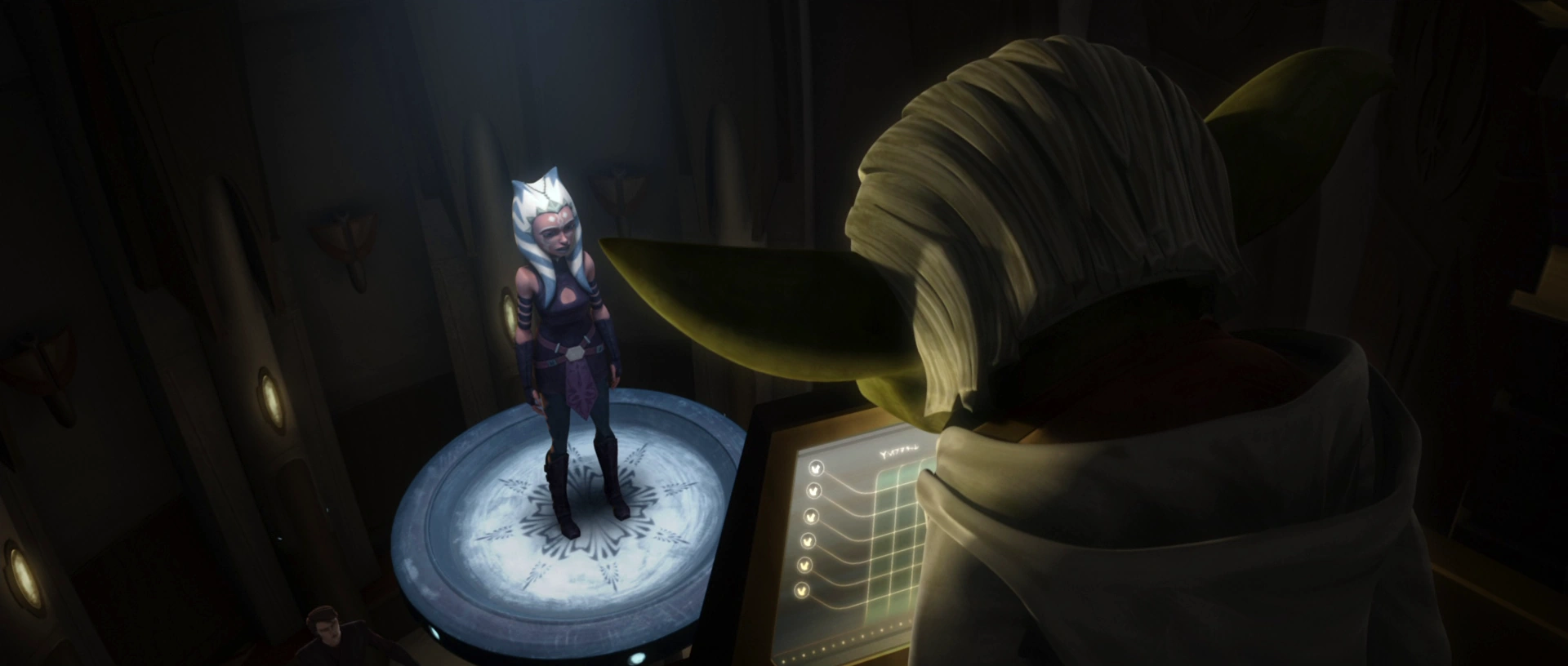
Due to the circumstantial evidence, the Jedi Council vote to expel Ahsoka from the order, despite Obi-Wan demanding they stand by her as one of their own. Anakin convinces Amidala to act as Ahsoka's representation during the Senate trial, where Tarkin will be the prosecutor, while Anakin tracks down Ventress. He does so, attempting to Force Choke and torture her into confessing, but Ventress tells him the truth, that she was knocked unconscious, that whoever took her blades still likely has them, that she agreed to help Ahsoka when it was clear they'd both been betrayed. Anakin fears the investigation is hopeless until Ventress mentions Ahsoka speaking to Offee to get the lead on the nanodroids. When Anakin confronts Offee, he tells her what Ventress had said, and Offee expresses shock Anakin would believe her story, asking who could have done it if not Ahsoka and Ventress. Anakin then ignites Offee's own lightsaber and attacks her, at which she defends herself with Ventress' blades, and the two do battle, falling out into the training grounds, where Tera Sinube helps Anakin, now wielding both his and Offee's blade, to subdue the young Jedi and bring her to justice. Once she is arrested, Anakin enters Ahsoka's trial with her, forcing her to confess. Off explains that she caused the explosion because she was disgusted by the state of the Jedi Order as nothing but pawns of the Republic, that the whole order is succumbing to the dark side. The charges against Ahsoka are dropped, and the council offers her a place back in the order, declaring this her greatest test. However, to everyone's surprise, Ahsoka refuses and leaves the temple. What's remarkable, though, is the show could have easily made her refusal an angry one, or just indignant. Instead, they make her motives complicated, they make her refusal a clearly difficult one. Anakin chases after her outside the temple and asks her to reconsider, telling her he himself has questioned leaving the Order at times. She responds that she knows he has, but that this is something she must handle on her own. The show hits its final notes perfectly, as Anakin watches, pained, as his Padawan walks away, having just hours earlier shouted at the council "You've already made your decision", seeing now all his passion, all his work, it couldn't save her, that the council and the Republic had failed her so greatly that this arc more than anything else makes clear why he will later turn his back on it all. Ashoka, shedding a single tear, walks down the steps of the temple, seemingly into the sunset, as silence creates a void where the usual burst of orchestration usually ends an episode, slowly being filled instead with somber music as the credits roll. Its a hell of a way to end a season, and indeed, makes for a brilliant and powerful series finale (possibly explaining why the sixth season is treated as "lost missions" rather than a direct continuation of the show).


Overall, Season 5 is....well, like I said above. It's a perfect demonstration of the series as a whole: it can be really pointless, kiddish and slow, but when its good, it's absolutely extraordinary. This season benefits from swapping out single episode stories in favor of 5 four-part arcs, and considering they're 3/5 in terms of gripping, clever, vivid storytelling, its fair to say this season is well worth the watch. Check back next week as we see the very last of the Clone Wars with Season 6: The Lost Missions.