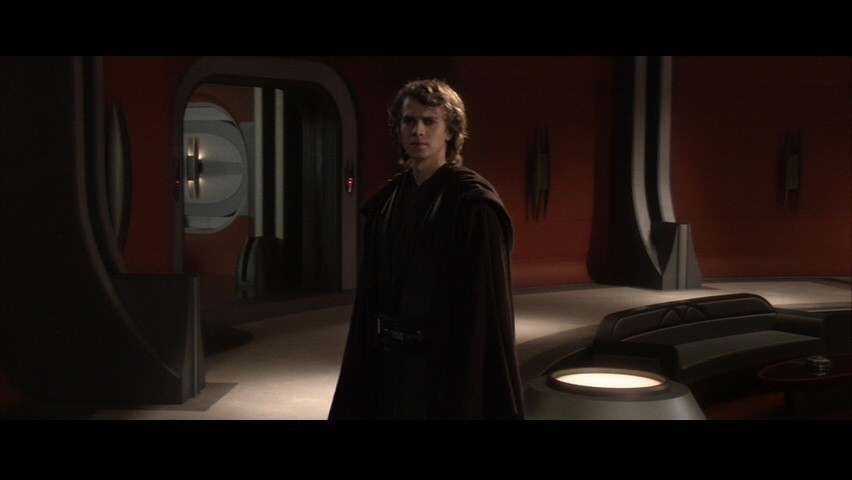
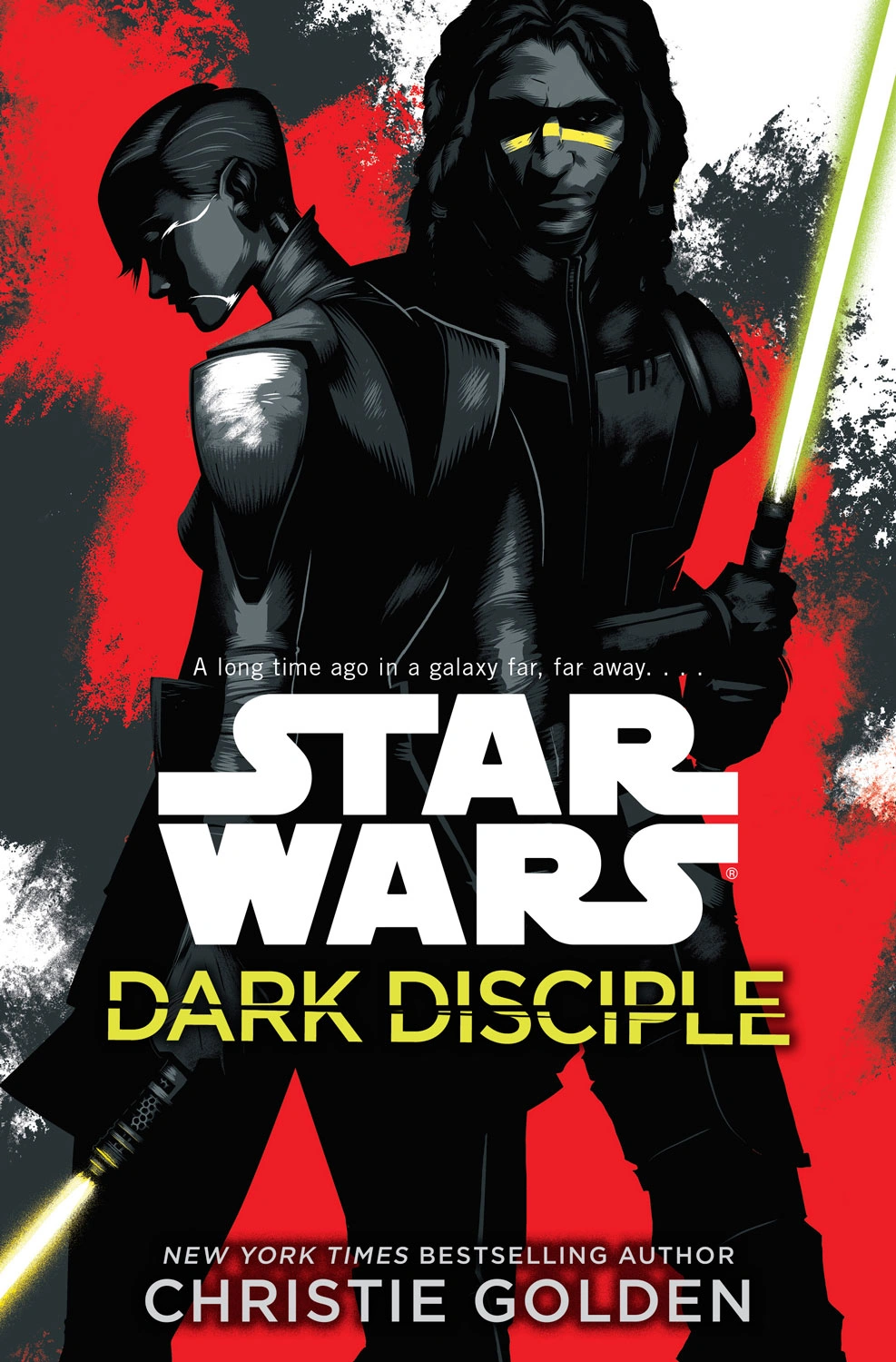
Friday, November 20, 2015

Star Wars Rebels: Season 1

First time here? Get caught up with the mission statementEpisode IEpisode IIthe Clone Wars moviethe first season of the showthe secondthe thirdthe fourththe fifththe sixthClone Wars LegacyEpisode III, and the lead-up to Rebels.


So, when last we left off, Cham Syndulla's daughter Hera had convinced a rogue Jedi to help strike a blow against the Empire. Together with an irate astromech, a Mandalorian street artist and a cockney Lasat, they stole Imperial supplies like galactic Robin Hoods from Ryloth all the way to Lothal, where one of the TIE Fighters they shot down (flown by Baron Valen Rudor, Lothal's most prominent Imperial pilot) is set upon by Ezra Bridger, a thief who seems to always be one jump ahead of the lawmen.

The series of novels, shorts and other media building that direct, linear line between Revenge of the Sith and Rebels brought me to the point where I was more excited to dive into this show than any other component of the canon thus far. Some of these characters I felt I already knew, others I wanted to get to know, and the quality of storytelling I'd seen on display throughout the previous works (especially Jason Fry's YA novel, that brilliantly straddled the line between accessible and exciting) would ideally be on display ten-fold in this series. Comic-Con attendees all passionately advocated for the show, friends who'd never normally set eyes on a cartoon sung its praises. Hell, the first season even garnered a Critics' Choice nomination.

How could it possibly go wrong?

Well, actually, the truth is I'm still wondering that, because thus far it hasn't. It's nailed it. It's honestly astounding how well Rebels' first season knocked it out of the park, considering how rough the inaugural season of Clone Wars was, and indeed how inconsistent even its best seasons could be. Yet there wasn't a bad episode in the bunch, and it possessed such a great sense of foresight and overarching plot, despite being isolated storylines each episode, that the series earns the awkward twists and clunky cameos you initially question, paying it all off in the end. It was a great thrill ride I recommend everyone take, and if you haven't, now's the time for a quick warning:

{HERE THERE BE SPOILERS FOR REBELS SEASON 1. Trust me, there are some really cool reveals and plot developments that occur in this first season that you're gonna be really pissed to have ruined for you. During the Clone Wars posts, I had plenty of people say "I just don't have time for a cartoon", but believe me, you wanna make time for this. It's well worth it.}
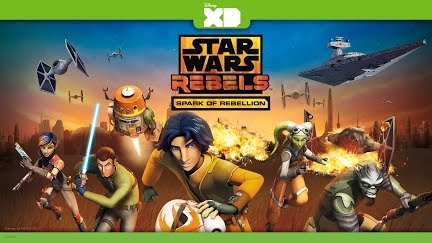

Season 1 was launched with a TV movie (thankfully not expanded and launched theatrically to no fanfare like a certain other film we shan't speak of) entitled Spark of Rebellion that serves as the origin story not only for the crew of the Ghost in their current form, but also their prime antagonist, the Inquisitor. The film originally aired on October 3rd, 2014 on Disney XD, but was later that month broadcast on ABC with an additional prologue scene that not only features the menacing Darth Vader, but actually got James Earl Jones to provide the voice.

And that's how we start, with Darth Vader instructing the Grand Inquisitor (who looks like a mix of the people of Utapau from Revenge of the Sith and the Son from Clone Wars) that Palpatine fears the "children of the Force" may be an issue and that he must hunt them down, before we're reintroduced to Ezra Bridger.

Ok, we gotta get this out of the way. Ezra is a great, engaging character who despite being young and appealing to kids never once slips into the cloying childish mold that Ashoka Tano was trapped in in the early Clone Wars seasons. He is also a shameless, shameless Aladdin knock off. I mean, the character design alone would be bad enough, but placing him on a desert planet, wherein he outsmarts armed guards in order to help people in need, while pilfering their wares for his own benefit, claiming "Hey, a kid's gotta eat" (which is essentially an abbreviated "Gotta eat to live, gotta steal to eat") is so painfully obvious that by the time Kanan straight up refers to Ezra as a street rat, you're just cringing at the parallels.

That said, the general pitch of Aladdin in space is enough to win me over. I'm cool just pretending its actually Aladdin in space (for the record, the equation "Classic literary character + "in space"= all of my money. It's true. I've sat through two different films that were essentially (or literally) Robinson Crusoe on Mars). Watching Ezladdin escape the pursuit of storm troopers and Imperial officers is fantastic, and the animation is so lively and fluid you're really drawn into the action in a way even some of the prequel films failed to do.

I have no intention of providing a full synopsis of the film when we've still got thirteen episodes to cover, but sufficed to say, Ezra falls in with the rebels, and in doing so discover's Kanan's secret Jedi past. Stealing a Holocron, Ezra manages to open it and hear Obi-Wan's message about Order 66, causing Kanan to realize Ezra is force sensitive. There's also a Wookie rescue, and David Oyelowo as a white guy with mutton chops. There's a lot going on in this film, basically, and the truth is the story is of little consequence beyond establishing who these characters are, what their motives are, and setting up Ezra to be taken under Kanan's wing. That said, it's a real rush the whole time, experiencing the excitement of classic Star Wars, the clear cut good guy vs. bad guy, crafty characters with quippy one-liners, free from the constraints Clone Wars had in so far as all of their fates are as yet unwritten. Spark of Rebellion sets the stage for a lot of potential greatness, and thankfully the series lives up to it.
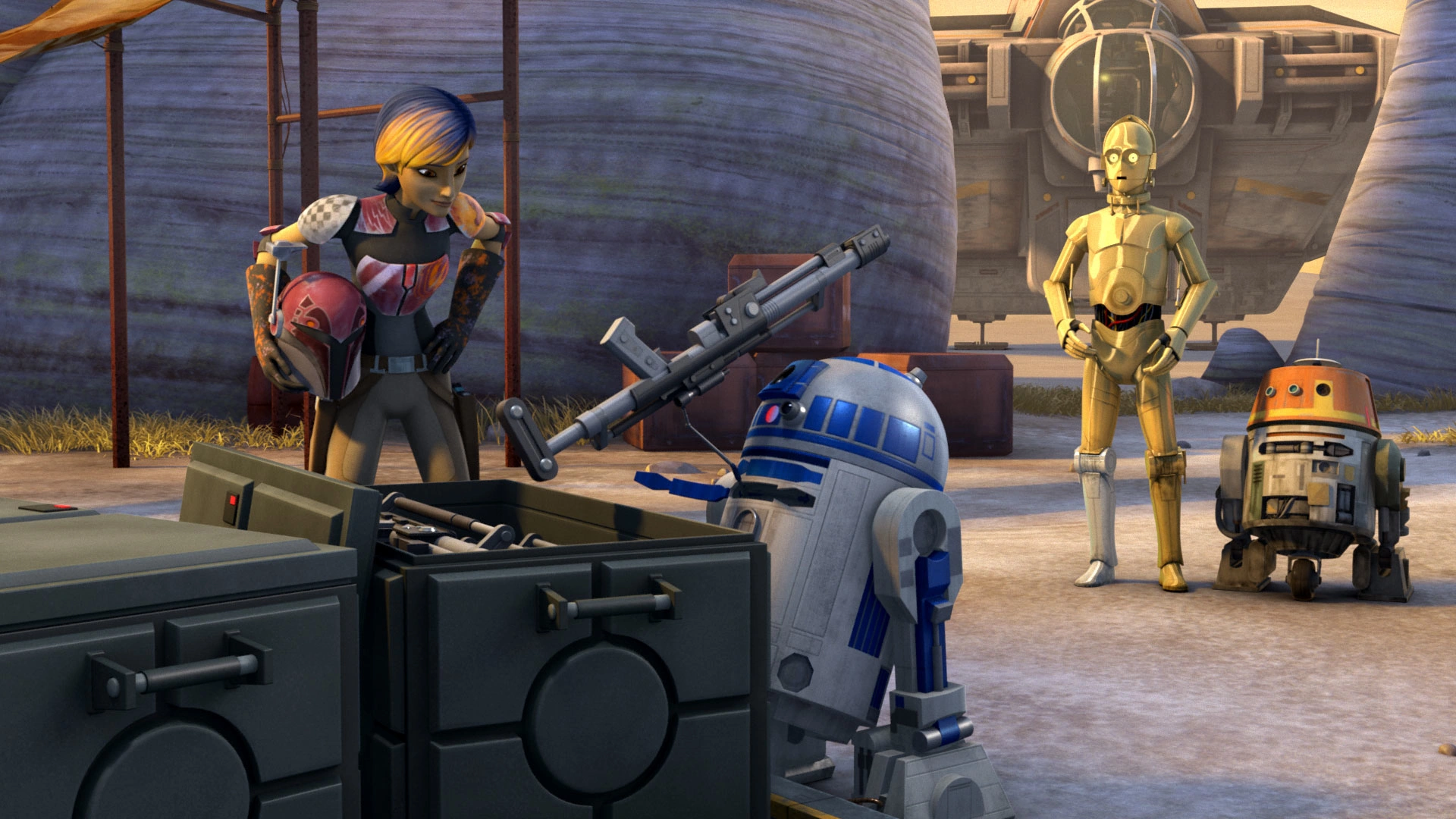

From the first episode, Droids in Distress, the series makes it clear we're gonna see a lot of cameos from the classic characters, but this particular episode could have honestly done without the famous droid duo of C-3PO and R2-D2. This very Firefly-esque plot about weapons smuggling digs deep into Zeb's past (the weapons they steal are illegal firearms, the exact model that was used to wipe out Zeb's people), fleshing out the character brilliantly, and gives the ever-crafty Sabine a great moment posing as an Imperial translator. There's some great action, some brilliant bits of dialogue that manages to sharply straddle the line between the Homeric antiquities spouted on the prequels and the  ragtag off-the-cuff comments of the original trilogy, and even a series-introduction for Bail Organa at the conclusion, who has already begun forming a rebellion against the Empire, and becomes very interested in the Ghost crew. Its hardly the best episode in the bunch, and would have made for a weak start were it not for Spark of Rebellion preceding it, but its an enjoyable episode all the same (especially if you are nerdy enough to spot the "cameos" from McQuarrie's original design for C-3PO and the droid from Star Tours).
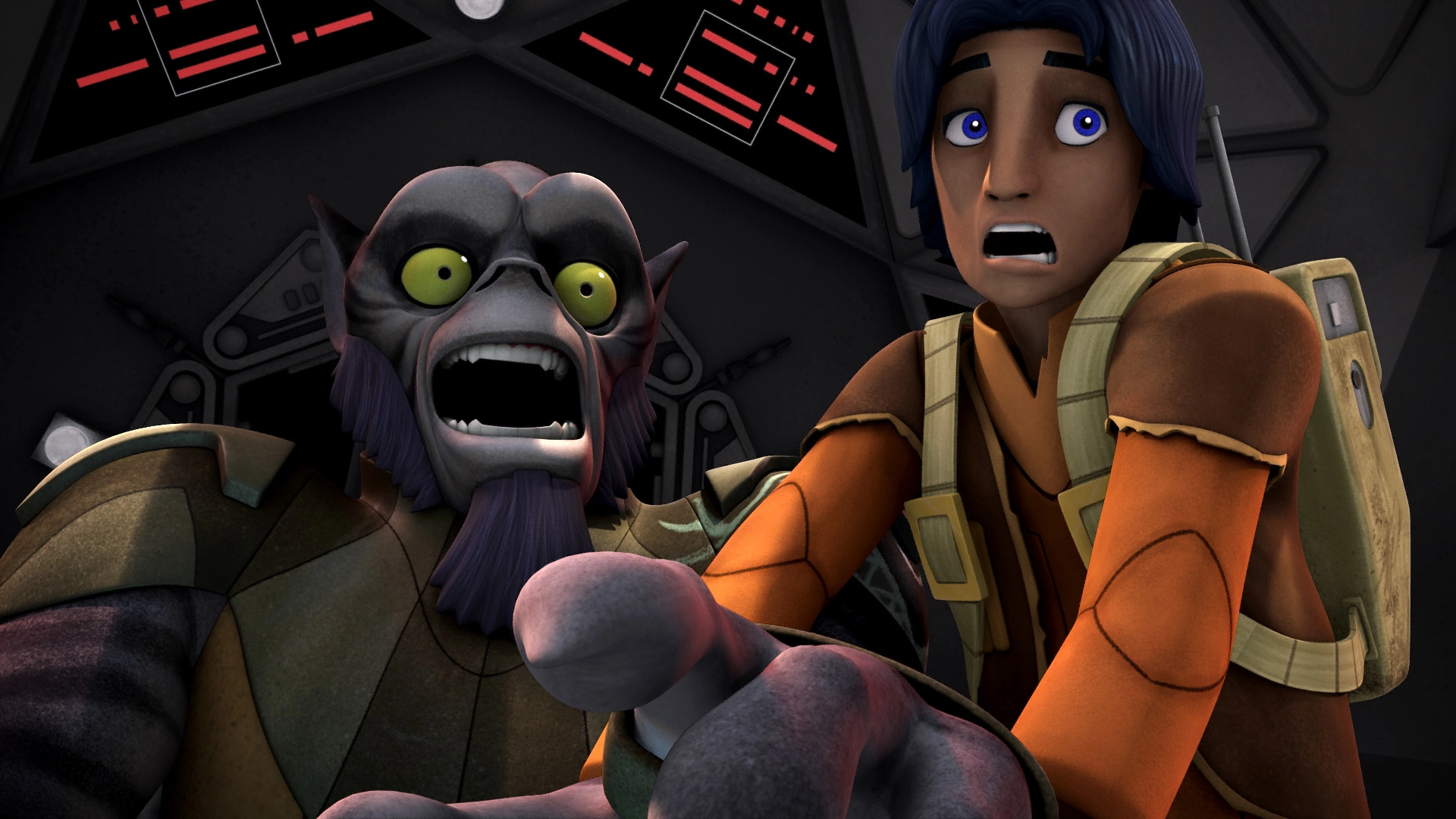

The show, as I said before, has a much greater sense of continuity than Clone Wars, so when Droids in Distress features Ezra saving Zeb's life with the Force, the laws of tv dictate that the following episode should be a buddy comedy wherein the life-debt is continually harped upon by the owed until circumstances cause the debt to be repaid. The episode's plot is negligible, involving Ezra and Zeb sent on what is really a team-building exercise under the pretense of obtaining an unobtainable fruit, which results in them tangling with Imperial forces (which results in my favorite moment of the episode, a bewildered stormtrooper asking "Wait, you did all this for fruit?" Its my sincerest hope that where the battledroids had been slapstick humor, the stormtroopers merely remark on the absurdity of  situations) and stealing a TIE Fighter. Such an episode would be the kind of trifle any other cartoon would put out as filler, and admittedly everything from the premise to the plotting feels so, yet as we saw (or as you'll see when you quit reading now and watch the show if you haven't, because seriously guys, there's some spoilers coming) that even that TIE Fighter, stolen in episode 2 and rarely mentioned again, gets paid off in the epic finale. All in all, the story is nothing to write home about, yet its a testament to how engaging this diverse cast of characters is, and how strong the writing and chemistry is that Fighter Flight is utterly engaging and remarkably fun.
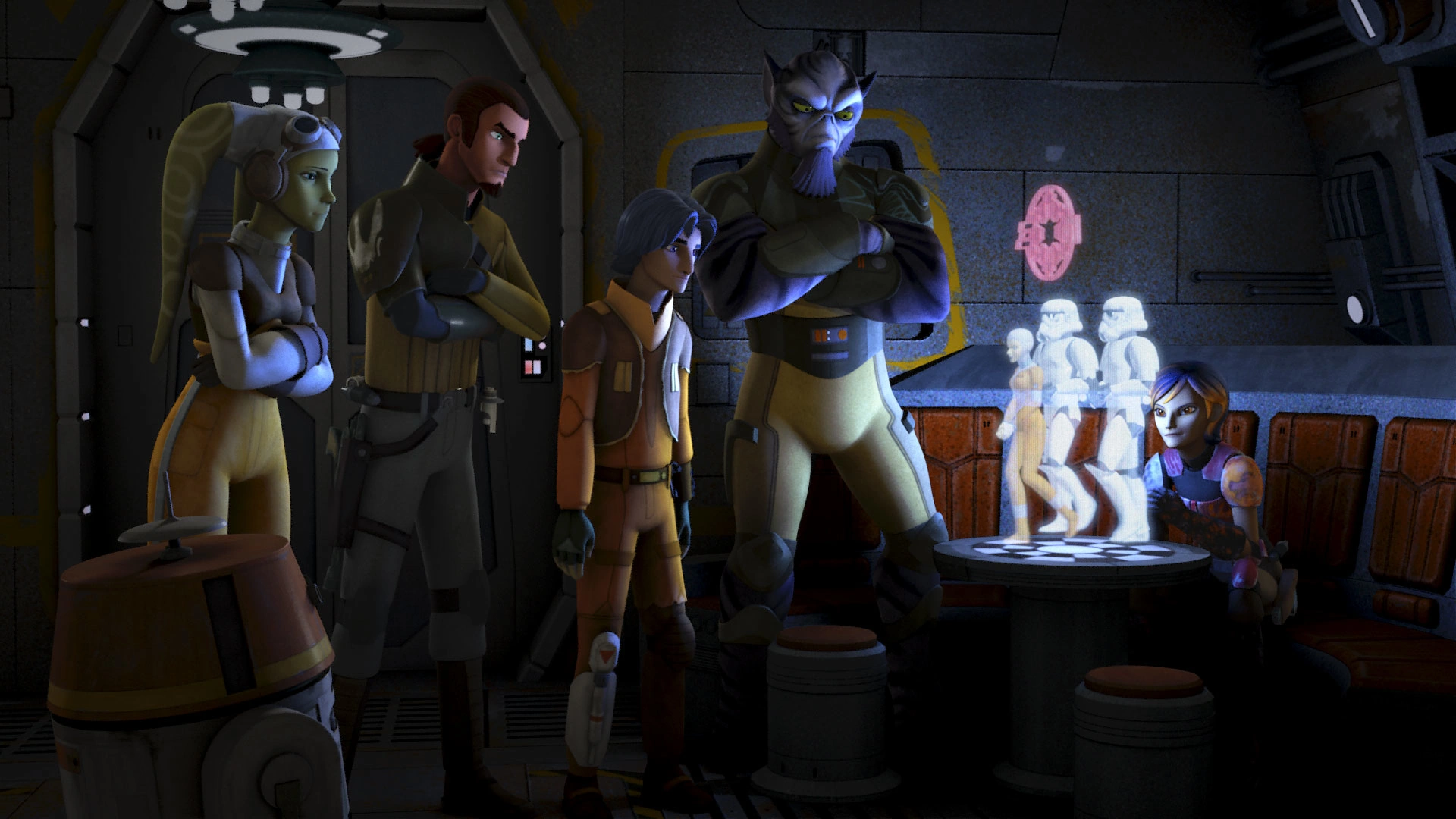

Holy s**t this episode is dark. Like, Revenge of the Sith level dark. Like Edgar Allen Poe, HP Lovecraft level dark. Like the Inquisitor utilizing the Holo-Net broadcasts to convince the Ghost crew that Luminara Unduli is still alive but in actuality having her mummified corpse act as bait for Kanan and Ezra's force sense to lure them into a trap level dark. Actually, it's not just like that last one, that's the plot. After a fun and fancy free Fighter Flight, Rise of the Old Masters gets hella grim, while still maintaining a sense of dashing adventure. From the opening scene of Kanan imparting on Ezra Yoda's classic mantra "Do or do not, there is no try" only for Ezra to question how such a statement is even plausible, since one cannot do something without trying, we're granted a sense of uncertainty not common for the Star Wars universe, the idea that what's happening may not be part of fate's grand plan, that Kanan may not be a capable teacher, that Ezra may not have any grand destiny after all. We're also given peeks at both the Inquisitor's impressive abilities (and totally boss dual bladed spinning lightsaber) and a potential larger rebellion with Brett Spiner (ST: TNG's Data, in a bit of fabulous franchise crossover) as the David Niven-looking Senator Gall Trayvis, known for his V For Vendetta-style diatribes on hijacked Imperial signals. Ultimately, Kanan comes to realize what Yoda meant: If Kanan tries to teach Ezra, than he isn't certain that he can. Only by having the confidence that he can and will teach Ezra the ways of the force can he do so without "trying". Its a surprisingly well-thought out explanation for the oft-quoted but never understood piece of advice.
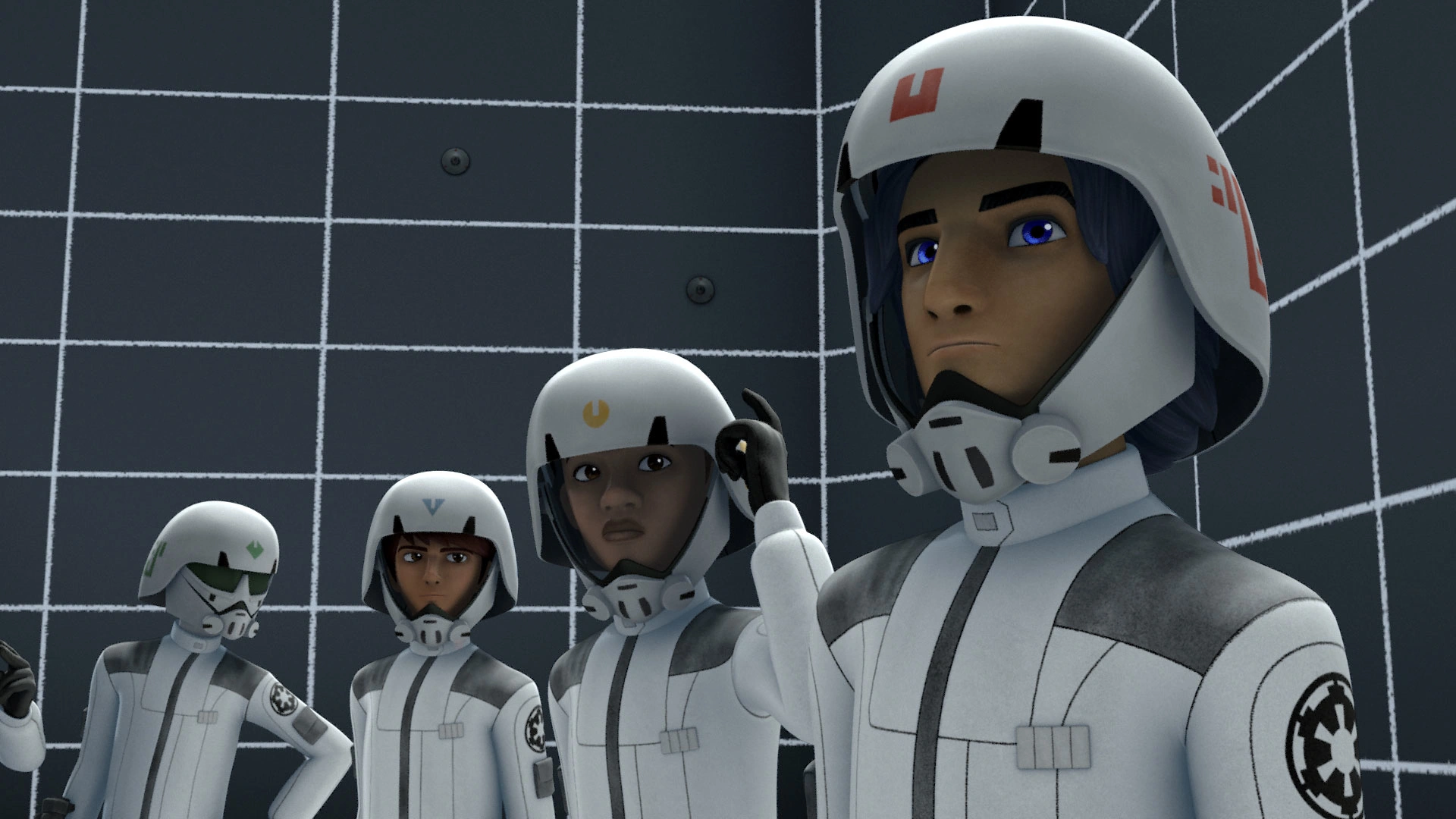

I truly believe Breaking Ranks is one of the best, if not the best, single-story episodes of the season, but I recognize I'm biased given for me and those digesting the entire canon, its not a single story, but rather a crossover with Jason Fry's excellent Servants of the Empire series. We see Ezra Bridger, undercover within the stormtrooper training academy, only to find he's paired up with Zare Leonis, also in the academy with ulterior motives. The story itself is pretty standard, with the entire plot becoming clear from the instant the premise is introduced to even the least amount of critical thought,  but its the exceptional execution combined with the idea of seeing two very different characters (privileged, educated Leonis trying to find a member of his family, and poor orphaned Ezra trying to be part of one) that we've grown attached to in books finally meet. Sure, there's some plot holes, namely how Ezra infiltrated the Academy at all, but I suspect Fry's second book in the Servants series, Rebel in the Ranks, which runs concurrent to the episode, will clear up all of that, and I for one can't wait to get to it.
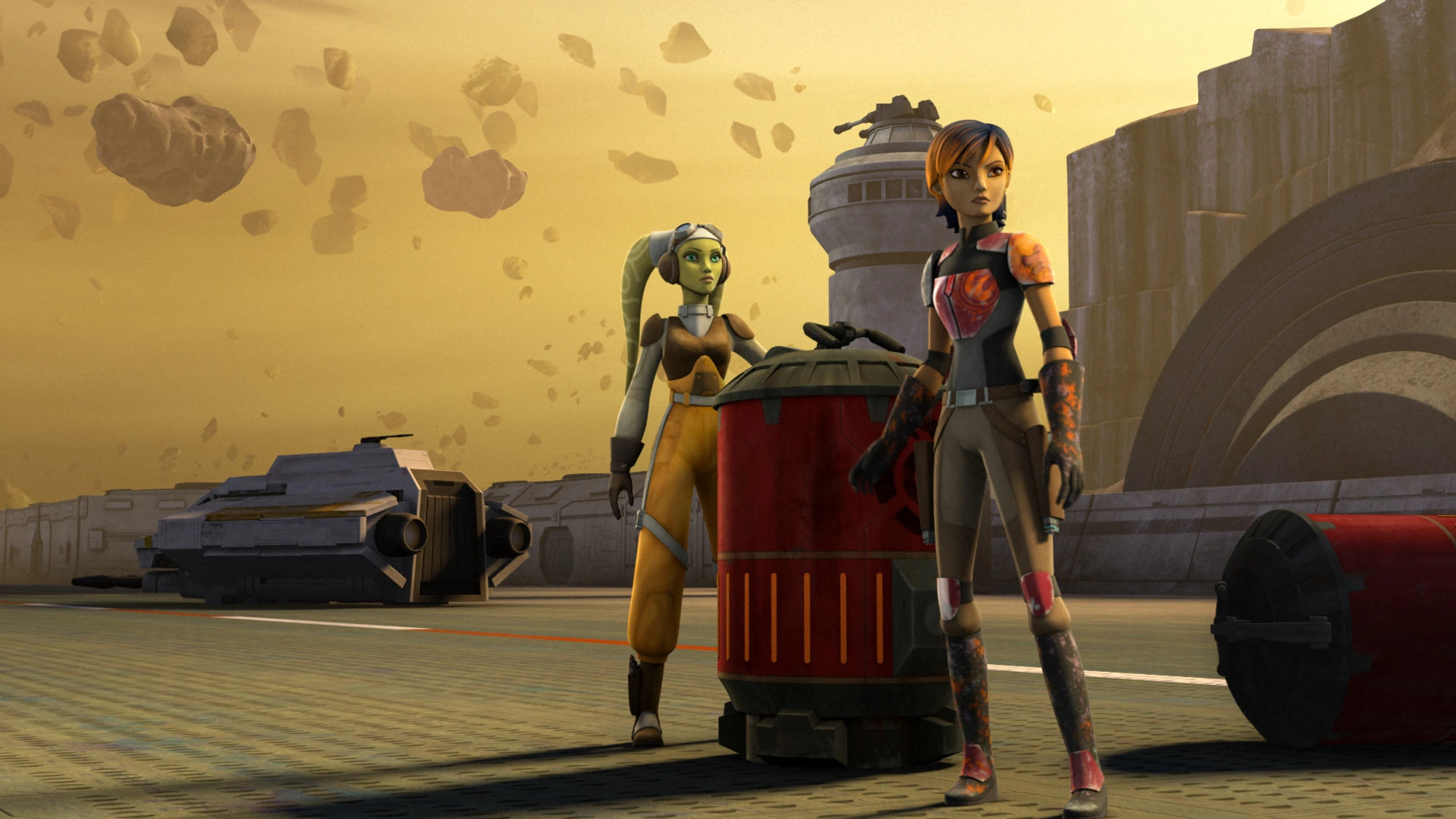

Despite Sabine being easily my favorite character in the series, I have to admit Out of Darkness is the only episode of Rebels I found myself apathetic towards. I recall admiring the visuals, particularly the lighting and the design of the alien creatures the pair encounter in the cave, the introduction of the mysterious Fulcrum,and being entertained in the moment, yet none of the episode stuck with me, nothing stuck out as memorable, and were it not for the callback it receives later on, it likely would have fallen to the wayside of my memory. That said, it still exceeds anything produced for the final season of Clone Wars, and certainly won't disappoint those looking for a bit of fleeting fun.
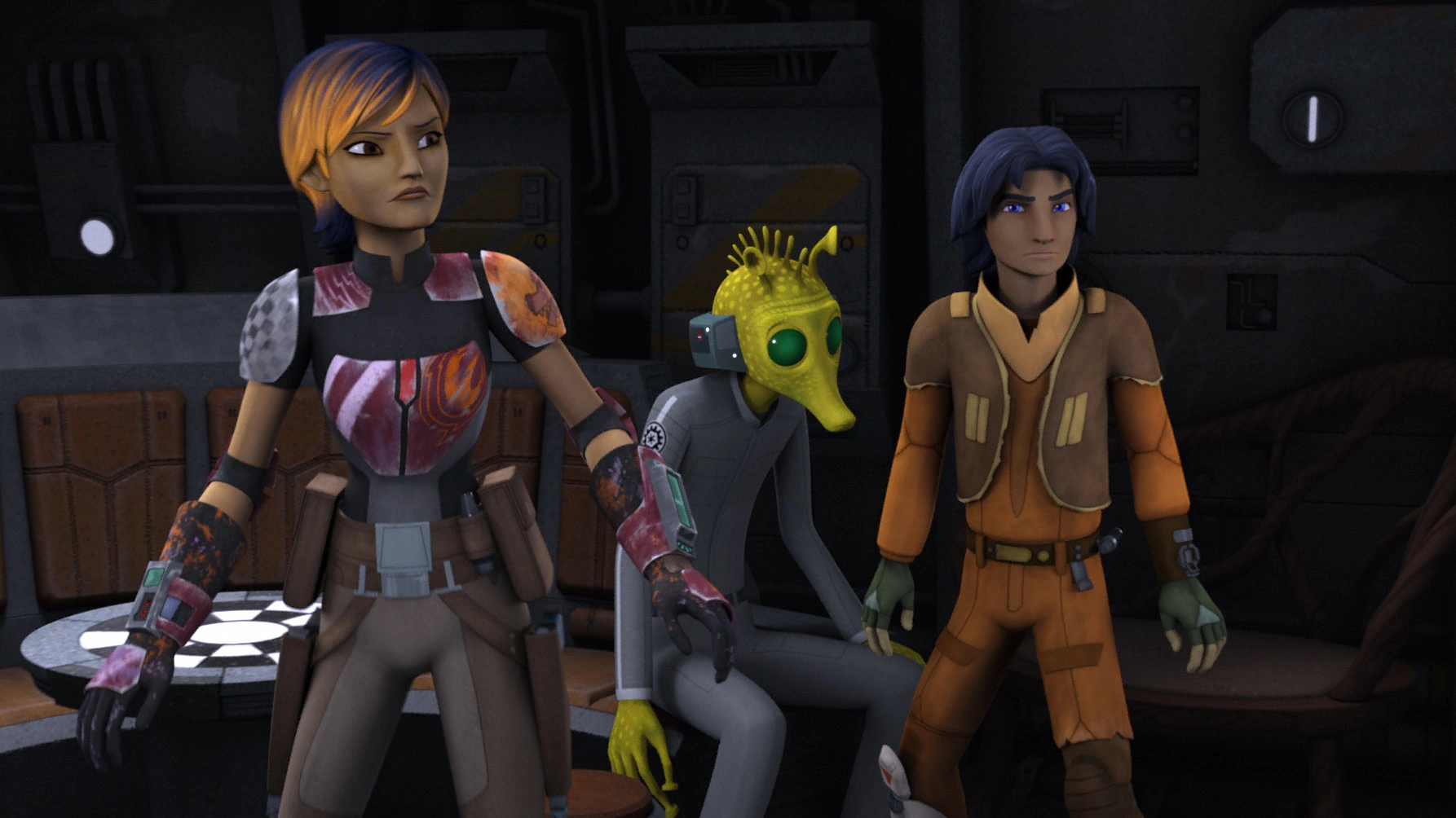

We get our first two-parter of the series with Empire Day and Gathering Forces, and its fantastic. Just the right length (meaning Dave Filoni learned from Clone Wars), and packed with great character moments, like Sabine's color-based sabotage, Kanan's play-drunkeness to evade Imperial forces, and Zeb's impatience to toss the fireworks. But ultimately, even though the episode features a good amount of background on Ezra's rebellious parents, and introduces Tseebo, who valiantly imbedded his brain with Imperial secrets in order to honor the now lost Bridgers, the arc's real purpose is to highlight the darkness within Ezra himself. From Kanan's angry concern when Ezra casually suggests killing the alien he finds himself unable to control with the force (in a tone that conveys he's not necessarily a stranger to lashing out at others) to coldly telling Tseebo he will never forgive him, to of course the harrowing final moments when Ezra calls upon the dark side in order to summon the mother creature to fight the Inquisitor, this episode turns the entire series on its ear, this was our Ned Stark moment, if you will, causing us to question all we knew about the medium. Could the character we'd been following all this time, could our main character, our archetypical orphan with a destiny, be evil? Could he turn to the dark side? In a series full of bad men getting redemption (Han Solo, Lando Calrissian, and ultimately Anakin Skywalker), could we actually witness the opposite? Have we ever seen a kids' show where the hero falls from grace? Of course, it's Star Wars, and not only that, it's Disney. There's no way, logic tells you, that they'd make a show with a main character, the one aimed most at kids, who'll become evil. And yet, Empire Day and Gathering Forces present enough to cause not only Kanan but we the viewer to have our doubts about the former street rat.
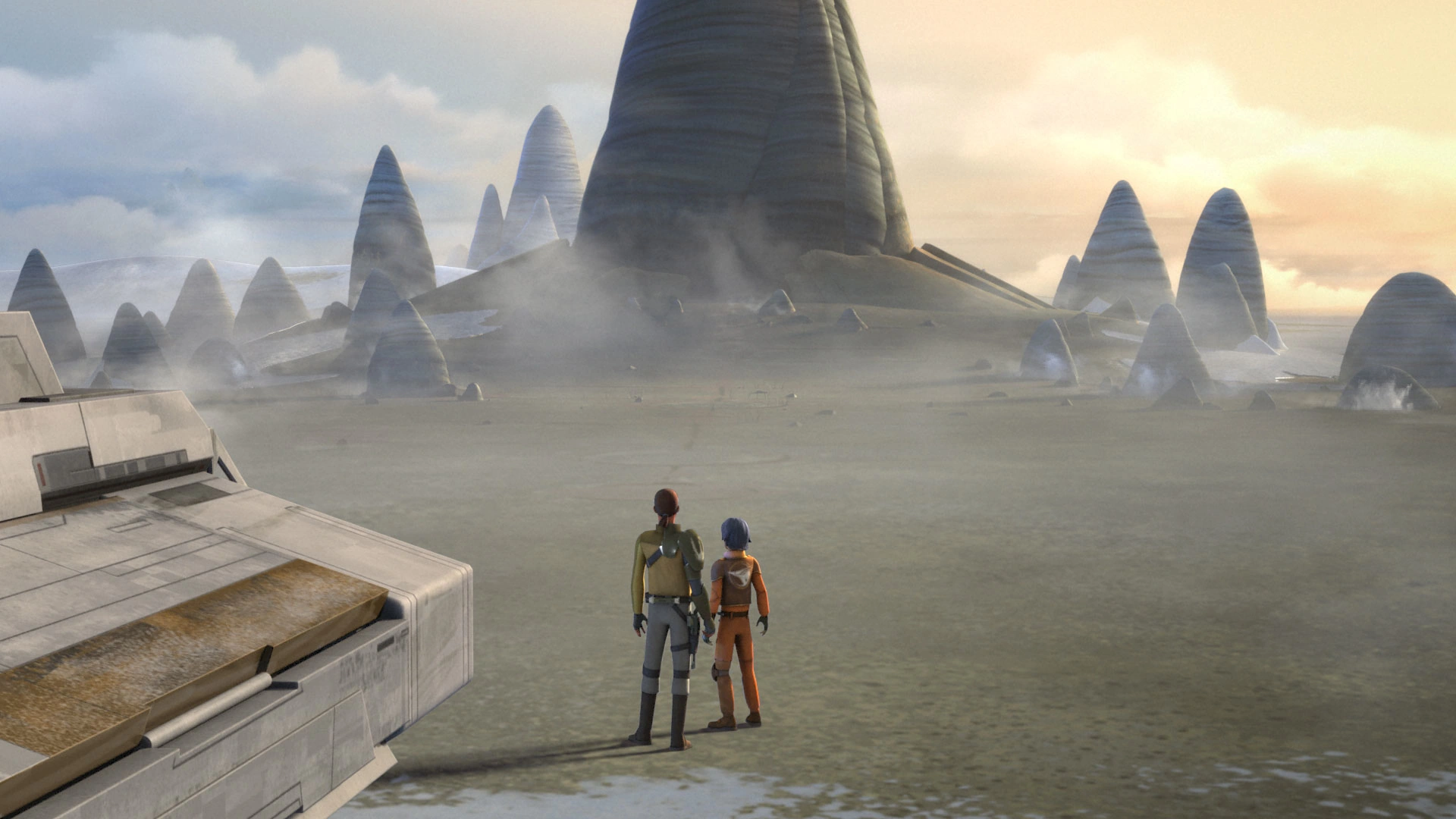

Path of the Jedi is the closest Rebels ever gets to its predecessor series in tone and structure. The plot is reminiscent of both A Test of Strength in that Ezra is searching for a crystal to build his lightsaber, and also the Mortis trilogy as all of the events that transpire are an illusion of the force in order to test Ezra,making it a little harder to get invested in the episode since you know its all a fantasy. Indeed, its only because Kanan himself seems worried Ezra might turn to the dark side that the episode has any real hook, since you think perhaps Ezra may actually fail his test, may prove unworthy, or may indeed receive a crystal, but one who'll result in an infamous crimson blade. Alas, despite some cool illusory moments that are ultimately inconsequential, everything plays out as you'd expect, with the only surprise being a voice cameo from Frank Oz as Yoda, who provides wisdom to Kanan assuring him about training the boy, and guiding Ezra through the same glowing lights that Qui-Gon had used to guide Yoda in the Clone Wars finale. This is one of the few times a full canonical knowledge of Star Wars may actually hamper the enjoyment of an episode, as I'm sure kids (or movie-only adults) who see this episode are dazzled by all of the things it does, expanding the Jedi mythology from what they know, but once you've been through the preceding novels and Clone Wars, everything this episode has to offer you've seen before.
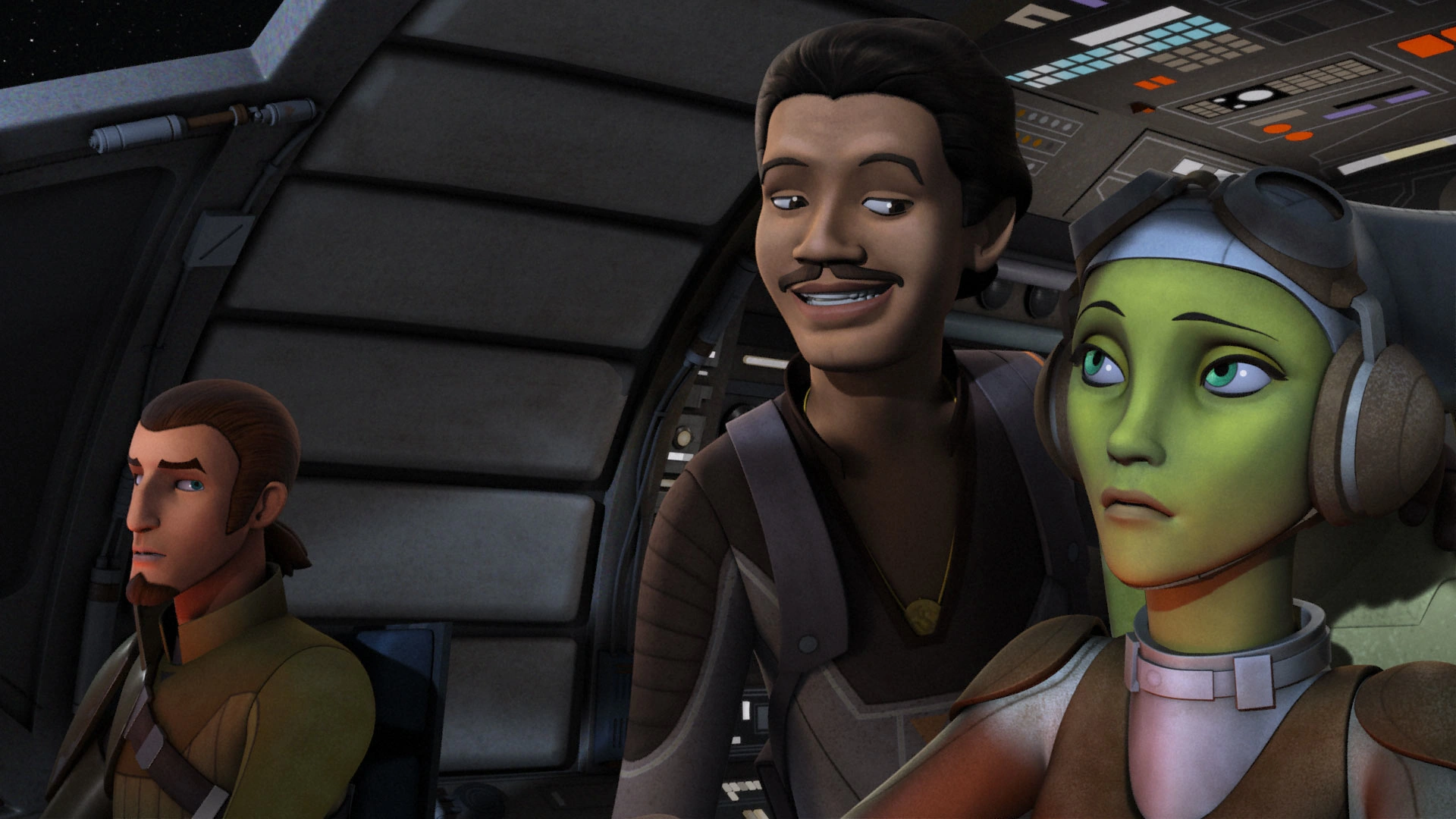

There will never be a more perfectly executed cameo on Rebels than Idiot's Array. Granted, from a chorine-canonical perspective, we should have no idea who this is. But...come on, we know. That's right, Billy Dee Williams is back as Lando, and it is spectacular. From a storyline whose main plot points are Lando a) winning Chopper in poker, b) selling Hera into slavery and c) very obviously trying to **** Sabine to the mere existence of my now-favorite Star Wars alien, the "puffer pig", who inflates when stressed, this episode is undeniably silly, unbound by any of the seriousness Clone Wars was oft to either be restrained by or flourish in (Hutt baby named Stinky aside). It's also fantastically fun, perfectly slick without a dull moment in the entire run time, some stellar voice work (the episode's main antagonist is Lopan from Big Trouble in Little China, in case Billy Dee wasn't enough to get you on board), and some great moments of humor that never seems to betray any of the serious character work they've done thus far (played for a joke, Ezra and Kanan's willingness to leave Lando behind in the grips of Azmorigan fits what we know about both characters thus far, especially considering the Kanan we met in A New Dawn). If you need one episode to convert a hesitant fan to Rebels, this is it.
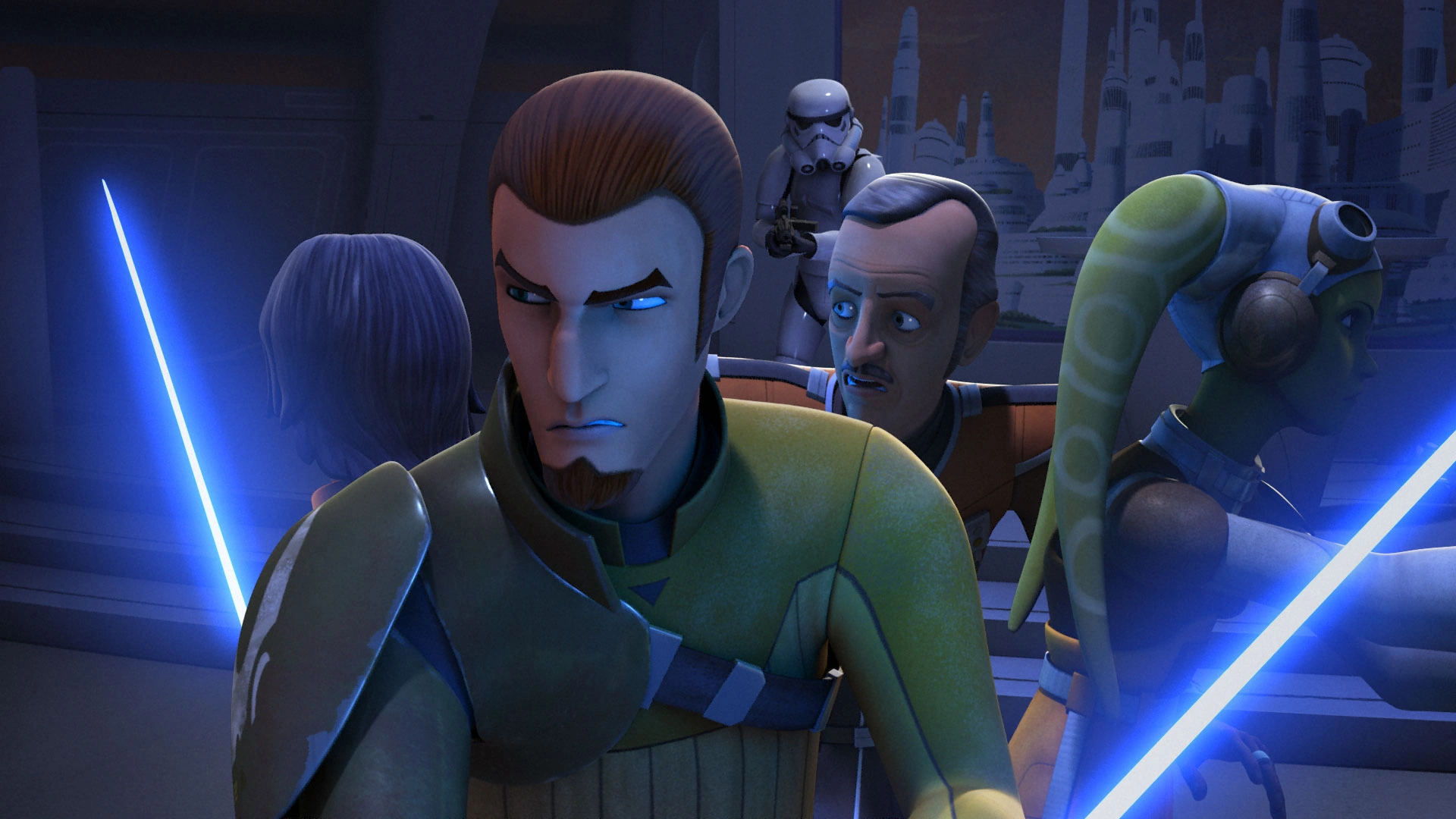

I know I've done a few spoiler warnings thus far, but I really must urge you to turn back if you haven't seen Vision of Hope, as this one's twist actually took me by surprise. After finding hints hidden in one of Trayvis' broadcasts as to his next stop, the Ghost crew finally meet the Senator in Exile in person, only to discover that he's in fact a puppet of the Empire, used to lure rebels into a trap. Apparently the Lothal rebels had stirred up enough trouble to get on his radar, so I guess that should be a plus in their book. Vision of Hope lacks the sort of powerful dialogue or stunning action sequences that brand the episode into your memory like the majority of the season does, though its nice seeing Zare return when Ezra, who is now receiving premonitions through the force, is being pursued by stormtroopers. I love seeing Zare be a "man on the inside", helping Ezra right up to the point where a stormtrooper can see, than instantly putting on a full Imperial guise, ultimately earning praise from his superiors. Apparently Vision of Hope factors into the third Jason Fry Servants book, Imperial Justice, so even if the episode itself isn't particularly remarkable compared to the rest, I'm fascinated to see how Fry fleshes it out.
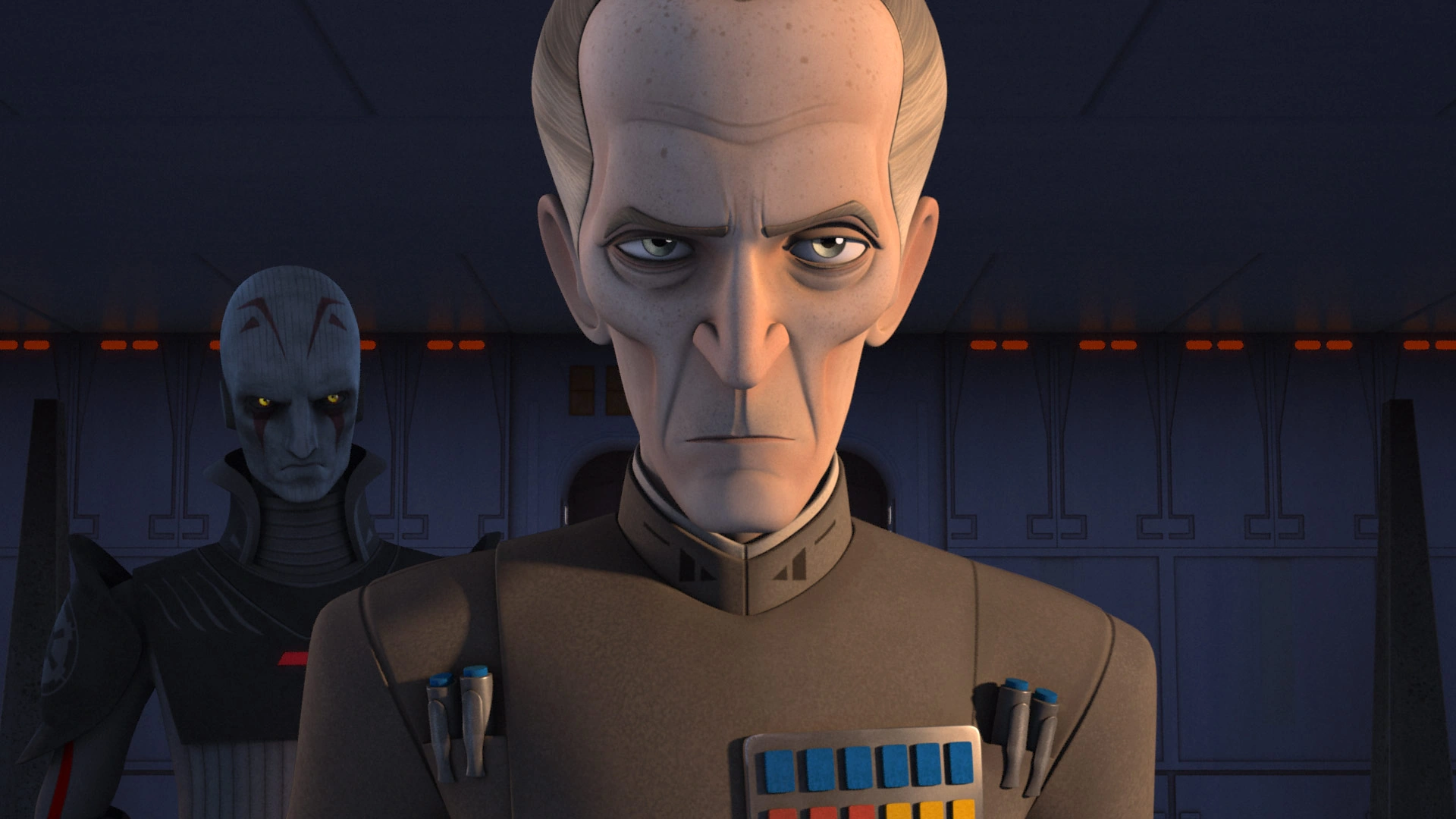

The three part finale Call to Action, Rebel Resolve and Fire Across the Galaxy pack a lot of fantastic moments, but for my money none are better than those that involve the ruthless, methodical left hand of the Empire, Grand Moff Tarkin. These episodes are easily the series most cinematic, with an imp[ressive amount of care going into lighting, shot choices, and editing, best exemplified in the sequence where Tarkin wordlessly orders two failed imperials execution, told through Leone-esque close-ups of the eyes of all in the room before the Inquisitor ignites his blade. There are some clever little storytelling techniques that add suspense, like the moment where Tarkin expounds upon the various other cells of rebels, reminding you once again that the Lothal crew are far from the only ones, robbing you of the assurance that "they can't die, cause they're the start of the rebellion". They in fact can die, and you really think they might, especially when Kanan tells Ezra to flee while he stays back to fight the Inquisitor, recalling Obi-Wan's fateful instruction to Luke in Episode IV.

The writing is top notch in these final episodes, from ominous statements like Hera describing Mustafar as "...where Jedi go to die", perhaps alluding to Anakin Skywalker's supposed death, or hinting that the Jedi who survived after Order 66 were rounded up there, to humorous taunts like Kanan's mocking "I see...I see...I see you getting more and more frustrated." Everything from the past season comes together neatly in this finale, from the stolen TIE Fighter from Fighter Flight (now colorfully repainted by Sabine) to the horned scoundrel from Droids in Distress, to the payoff on the appearance of Bail Organa and the reveal of Fulcrum, but we'll get to that in a moment. First, let's address the series' finest action sequence, Kanan facing off against the Inquisitor. From the stellar fight choreography utilizing both the blaster and lightsaber portions of Ezra's lightsaber ("I never thought of that" Bridger remarks) validating the design as something with more intent than to just be "cool" and sell more toys to some great dialogue on par with the best Clone Wars ever offered, when Kanan tells the Inquisitor that pushing Ezra off the side of the platform they're fighting on was a mistake, and the Inquisitor says "Why? Because you have no one left to die for you?" to which Kanan replies "No, because I have nothing left to fear" before redoubling his assault. Ultimately, the Inquisitor chooses to end his own life rather than surrender to Kanan, explaining that their are some fates worse than death (one can only assume he's referring to the torture the Emperor submits failures to, but there could be some greater mythology about Inquisitors that's yet to be revealed), and we're treated to a moment that's both humorous and also hints once more Ezra's fate may not be so beatific as he and Kanan find themselves with only one option of escape, the Inquistor's TIE, to which Ezra jokingly says "Well, we know he's not gonna use it" mere moments after the character plunged to his likely excruciating death. Kanan's comment of "You know what kid? You worry me sometimes." works perfectly as a punchline, but also hints at an actual underlying concern has about Bridger. After all, like Kanan, Obi-Wan was a Jedi who was capable of going rogue, of straying from the Jedi code, disregarding commands of the council, engaging in reckless tactics, and even falling in love; his pupil being so susceptible to the dark side may well have been in part due to his own intermittent departures from the rigid structure of the calling. So to may we see Kanan's straying from the ancient ways result in Ezra falling into the clutches of the Sith.

Of course, the biggest punch the finale packs is the reveal of Fulcrum. Unbeknownst to the rest of the crew, Hera has made them a part of a much larger rebellion, through the assistance of Bail Organa. After escaping Mustafar in a ship piloted by Chopper, they find the Ghost running alongside them, and wonder who's flying it. They board their ship to find a hooded figure descending from the cockpit as Bail's hologram expounds upon the broader rebellion to the crew. Finally, the mysterious Fulcrum reveals herself to the crew to be...holy s**t it's Ahsoka. After brief mentions of her in Tarkin and Lords of the Sith, and the nagging concern that despite leaving the Order she'd been killed during Order 66, it turns out not only is Ahsoka alive, but she's one of the founders of the rebellion. Granted, for those coming to the series with no background, or "movie-only" background, this reveal is meaningless, but for those of us who've kept with the canon all this time, its an incredible, mind-blowing twist that makes everything thus far feel so much more unified and sets up a fascinating dynamic for the series going forward, especially since the final moments reveal Darth Vader's arrival on Lothal, complete with the ominous hiss of his breathing playing over the final "Star Wars Rebels" logo of the season.


Ultimately, Rebels packs a hell of a punch, with a season that on the whole surpasses any single season of Clone Wars with an array of episodes that seem infinitely rewatchable, due to a smartly plotted overarching story that never hampers down individual episodes (a certain Doctor Who show runner should probably take notes) and brilliantly crafted characters whose personalities and chemistry make you want to watch even the most overdone plot lines just to see how they react. It's well worth the time, and proves to be a great addition to the overall Star Wars franchise, bringing in new viewers and reminding the old what we loved most about the classic series.


Well, that's it for this week. If time permits, we may take a look at the expanded Rebels canon work, like the remainder of Jason Fry's Servants of the Empire, the remaining two Rebels video games, and the technically canon comics which appeared in the Rebels Magazine which is thus far only available in the UK. It's a hell of a tall order, all things considered, but if life permits we'll take a look at that midweek, and then next Friday we hit the final countdown. That's right, next week we take a look at the masterpiece that started it all, Star Wars (sigh...fine...Episode IV: A New Hope, if we must). See you guys then.

Friday, November 13, 2015

Star Wars: Novels, Comics and More

First time here? Get caught up with the mission statementEpisode IEpisode IIthe Clone Wars moviethe first season of the showthe secondthe thirdthe fourththe fifththe sixthClone Wars Legacy, and Episode III.


So, for those of you who followed along on the schedule, this week's post was meant to be solely devoted to John Jackson Miller's A New Dawn, the first novel of the new official canon. In the mission statement for this whole endeavor, I delved into a diatribe about my reasoning for only doing this one novel, pertaining to timing and intent, as well as the questionable completeness of other elements of the canon, and while some of that sentiment still holds true, I couldn't help but feel the sentiment Cham Syndulla expresses in Lords of the Sith, that I'm too far in to turn back now. It's true. I've devoured most of the canon, and A New Dawn turned out to be such a quick read, I felt it best to devour the rest. But fear not, much like the Clone Wars Legacy post, I don't intend to dip much into spoilers for those who haven't delved into anything outside the films.

That said, anyone who hasn't gone exploring outside the cinematic really should. Unlike the inconsistent Clone Wars Legacy, not only was there nothing within this collection of the canon that disappointed, and strangely some of the most enthralling material was where you least expected it to be.

Obviously, after the Disney/Lucasfilm merger, the sole casualty outside the Expanded Universe was the Clone Wars series, cancelled and relegated to the storytelling means we discussed in the Legacy column when a deal couldn't be reached with Warner Bros., but showrunner Dave Filoni was offered a very appealing consolation prize: building a new series bridging the two cinematic trilogies, showing the rise of the rebellion and utilizing ideas he'd originally rejected by George Lucas himself for the Clone Wars series, including a rogue jedi, a big bruiser alien and a freighter traveling the galaxy. However, seeing as the Rebels series takes place a full 14 years after Revenge of the Sith (it needed time for the Empire to build into the imposing establishment), the powers that be quickly set about filling the gap between the film and series, starting with Miller's introduction to two of the protagonists of the Rebels series, and then commissioning various projects to explore the rise of various Imperial figures, introduce audiences to the various characters who would feature prominently in the upcoming series, and flesh out the planet Lothal, the primary setting for the events of Rebels. Utilizing short stories, both in the monthly Star Wars Insider and in a collection entitled Rise of the Empire (which also included the full novels Tarkin and A New Dawn, well worth picking up), a singular thread runs through the various stories, making one true feel as though they're experiencing a singular linear multi-media narrative that makes for a thoroughly enjoyable ride through the years instead of merely a disjointed time jump (from this vantage point, anyway. The various items discussed below were released throughout the run of Rebels over the span of a year, so to one consuming them in real time, it may perhaps have failed somewhat haphazard and disjointed. However, credit should be given to the new Story team, for endeavoring to plan ahead for future fans looking to dive in, making their new canon far more accessible than the previously massively convoluted Expanded Universe). 

So, without further ado, let's dive right in:


Kanan: The Last Padawan Vol.1

Now, for clarification, we're thus far only going to address the first five issues of the first arc of Marvel's Kanan comic book, though the first volume also contains a sixth (which is the kind of specificity that takes this Star Wars blog to a new and nerdier low, I realize). This is because, while some jumps in the timeline are unavoidable (Force Awakens-era flash forwards in pre-Empire Strikes Back YA novels, and Clone Wars flashbacks in A New Dawn, for example), the sixth issue of the Last Palawan story arc acts as a conclusion to the Rebels-set framing device that introduced the main story, which is set immediately after Revenge of the Sith, so we'll deal with that in time.

For those reading from a chorine-canonical perspective, the comic opens with a strange batch of people aboard a ship bound for the planet Kaller, but those who've already seen the Rebels series know these to be the crew of the Ghost, and the group's leader to be former Jedi Kanan Jarrus. When Twi'lek pilot Hera asks if Jarrus has ever been to the aforementioned planet, it triggers the traumatic memory of his escape from the deadly Order 66. Without dipping into any serious spoilers, Kanan: The Last Palawan provides some thrilling moments that leap right off the page, as well as a powerfully heart wrenching moment at the conclusion of the first issue, when Kanan, a young Palawan whose true name is Caleb Dume sits beside his Master Depa Billaba and several clone troopers, palling around after a fierce battle during the Clone Wars. One of the troopers steps aside to retrieve a transmission, and the final panel reveals it to be the fateful Order 66. The series continues to cap off each issue with such cliffhangers in true Marvel fashion, merely missing the alliterative Stan Lee demands to pick up the next issue. By the end, while its clear there's much more story to tell, the reader has a sense of how Padawan became pirate, and grow instantly attached to what proves to be our first example of the roguish space cowboy archetype that would go on to populate the Star Wars franchise to great adoration. Absolutely worth reading.


"Orientation"

Originally appearing in Star Wars Insider Magazine 157, "Orientation" attempts to tie into Paul S. Kemp's Lords of the Sith, yet is written by John Jackson Miller, author of A New Dawn, and prominently features the character of Rae Sloane who first appeared in Miller's novel (but would prove to swiftly be a fan favorite, racking up a total of 5 literary appearances and growing). It attempts to fit itself in early on in Lords of the Sith, which finds the Imperial duo of Palpatine and Vader en route to the planet Ryloth, by having them supposedly detour at the Defiance Flight Training Academy, wherein they attempt to weed out treachery in the ranks. Yet if the story fits within the timeline of the novel, it does so clumsily, and while the writing itself isn't lazy, its structure perhaps is, lacking any real purpose for its primary characters. Canonically, yes, this is the first time we've seen Vader and Palpatine dispute the proper way to deal with dissidents, but such issues are also raised in the novel itself, to a better degree. Ultimately, the main purpose it serves is to be the catalyst to Sloane's meteoric rise within the Empire, as she helps expose the traitor, earning Vader's admiration. Yet beyond that, there's nothing within this short story that fleshes out any aspect of its main characters, nor expands the universe at all. It's hardly abysmal, but is inconsequential, so its hardly worth breaking one's back to try and locate this back issue of the Star Wars Insider Magazine solely to read this, unless one is heartily invested in the Sloane character (this does prove to be a crucial part of her biography, referenced in a later short story) or the intricate aspects of the Empire. That said, if you have a copy readily available, and won't be as vexed as I was about its awkwardly forced placement within the overall Lords of the Sith storyline, its not a bad way to spend a few minutes.


Lords of the Sith

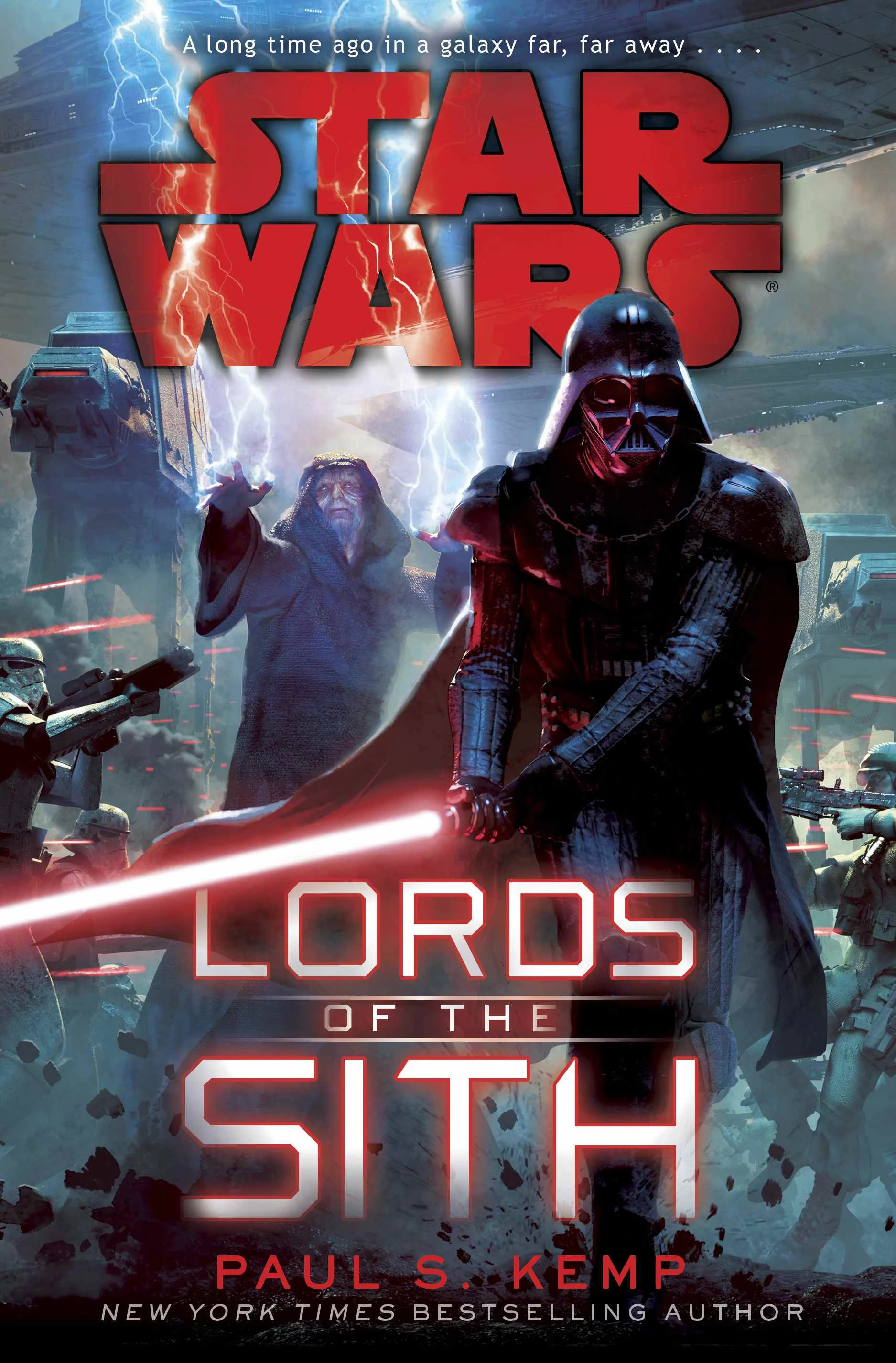
As a story, Paul S. Kemp's Lords of the Sith is serviceable. Given that its main characters are Darth Vader and Emperor Palpatine, and that its main plot involves an attempt on their lives, there's little stakes to the story; anyone with even a passing knowledge of the franchise knows both characters survive for decades after this novel, and even without that, logic would simply tell the uninitiated that two characters whose origins were charted for three films and six seasons of television would not be dispatched in an under-promoted novel (I say under-promoted as, for example, Lords of the Sith received none of the vitriolic attacks Aftermath did for "forcing" nerds to accept diversity by including a gay character, despite Lords doing so a full five months earlier with Moff Mors, as it was barely on anyone's radar at all). As a character study, however, it proves to be fairly enthralling once they pick up steam. It's weak link is its rebel faction, a group of Twi'lek run by Cham Syndulla (who you may remember from the Ryloth-set episodes of Clone Wars), who outside of Cham and the violent Isvall (who gets a truly great scene in the murky Ryloth underbelly early on) prove to be fairly  indistinct from one another, and given their plans are guaranteed to fail, provide little interest for the reader. More interesting is the double dealing Imperial Belkor Dray, manipulating both factions to get ahead, and ultimately {SPOILERS} his descent into madness proves to be the most surprising and engaging thing within the novel beyond the two Sith lords. It's the interaction between Vader and Palpatine, however, that makes the novel worthwhile. We get insight into Vader's mind, his remembering Padme and Obi-Wan, even Ahsoka Tano (though I loathed her at first, I grew so fond of the character by the end of the Clone Wars series that I'm grateful to see a mention of her beyond it). Through Palpatine's various mind games and the resistance Vader sometimes offers, we're painted a portrait of Vader as someone who, while quick to anger and ruthless when he wishes to be, himself opposes some of the more sadistic tactics of his master. The novel has some truly chilling moments, no more so than towards its conclusion, when the two take on aliases, words from an ancient Sith language with ominous meanings. It's a nice touch, the idea that Vader and Palpatine are able to speak an ancient Sith language, and simply making canon that such a tongue even exists. The novel is peppered with these wonderful little insights, and makes for a wonderful read after a somewhat slogging early portion. Though there's nothing revelatory within the text, it provides some good connective tissue between the Clone Wars/Republic era and the current age of the Empire, as well as remind us that the well-intentioned Anakin was always there behind the mask, he'd simply lost his way.


"Mercy Mission"

"Mercy Mission" admittedly isn't much to write home about, serving as an epilogue of sorts to Lords of the Sith more than an introduction to Tarkin, the novel it precedes in The Rise of the Empire collection, but fits much more elegantly and organically with it than "Orientation" does. It takes place a year after the events of the novel, and features several of the characters, including Moff Mors and some of the Twi'lek who survived from Cham Syndulla's ill-fated Free Ryloth movement, with Cham's daughter Hera now involved as well. The movement has seemingly lost interest in killing Imperial forces, and instead focuses itself on delivering goods and supplies to those in need, rebelling against the Empire by smuggling. Long story short, its the closest you'll ever get to a Firefly story in the Star Wars Universe, so much so that amongst all the unsavory characters and talk of medical supplies and drop points, when the team's ship eventually makes its inevitable escape, my mind involuntarily started to sing "Take my love, take my land, take me where I cannot stand." Yeah, its true you really could swap out the names Hera and Goll with, say, Kaylee and Jayne, and you wouldn't notice a difference, save for the final pages where Hera contemplates how she'd one day create a more organized and devoted rebellion (serving as a prequel to her doing just that in A New Dawn), and I'm not sure if that's a negative or not (for me, I'll take any taste of Serenity I can get). That said, if just for a bridge between Lords of the Sith and A New Dawn, its worth a look.


Tarkin

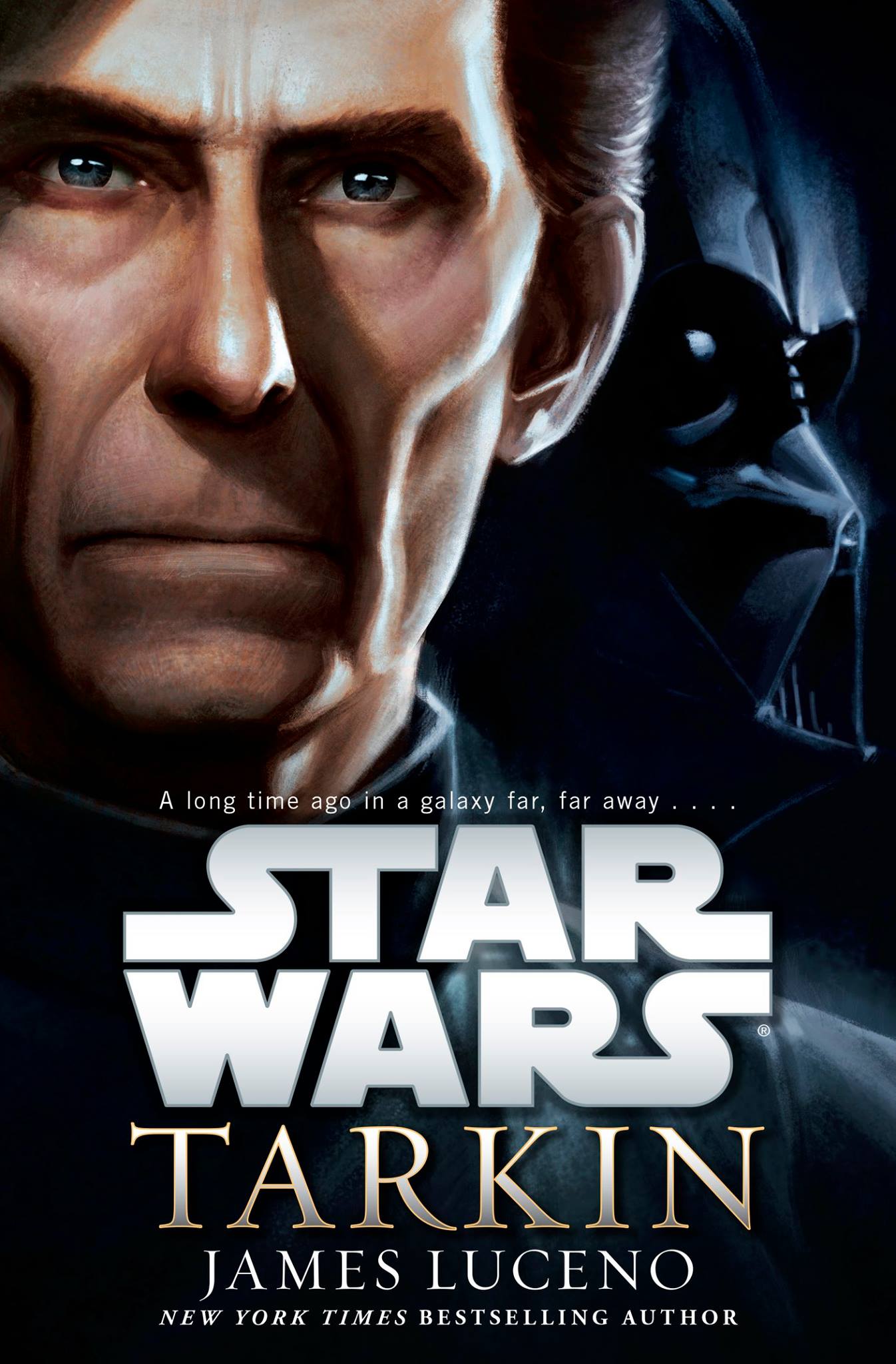
This is one hell of a novel. It's the novel I've preached to people since the moment I shut it. It's my argument in favor of tie-in novels to movie-only fans. James Luceno did an incredible job of crafting an intense, atmospheric, and utterly engaging portrait of a lesser character within the Star Wars Universe, yet he instantly managed to turn Peter Cushing's one-off (besides his brief appearances in the Clone Wars series) Imperial into my favorite character in the entire franchise. Ruthless but eloquent, tactical and practical, a gentlemanly elegant left hand of the Emperor to counter the brash and brooding Vader at Palpatine's right. The novel splits its narrative between Tarkin and Vader, disdainful rivals pitted together on a mission by the Emperor to track down traitors in order to forge a mutual respect between the two, and the young Wilhuff Tarkin's training within the wilderness of his home world. Luceno not only crafts the most engaging story in the novel, by imbuing it with enough biographical information to make it more a novel of "how did we get here" rather than "where will this go", helping it overcome the issue of stakes the plagued Lords of the Sith or many other of these prequel endeavor; he's also a very talented writer outright, the first and only novel within the canon I've experienced thus far whose prose isn't merely serviceable, but actually good (I've accepted I'll never get Joyce or Nabokov talking about lightsabers and Wookies, but the occasional Rowling or King level prose is nice to experience). I could talk for hours about this novel and still have more to say, yet I also wish to leave as much to the reader to discover as possible, so I'll merely leave it as being a must-read, and my favorite piece of material of any medium in the canon thus far.


"Bottleneck"

Ok, so it's clear from my writing above I will gladly take more Tarkin, any way I can get it, and pairing him up with the most interesting part of A New Dawn, the villainous self-help guru, Jim Kramer/Donald Trump stand-in Count Vidian makes for a thoroughly enjoyable read (and the best piece of canon writing, both from a story and prose perspective, from John Jackson Miller). Yes, it attempts to replicate the Vader/Tarkin Midnight Run-esque dynamic with Vidian/Tarkin, but the story itself is interesting enough (dealing not with rebels but with an ideological battle of whether capitalism can truly function in a totalitarian society) that it doesn't really stand out. It serves as a good lead-in to A New Dawn, giving us a taste of Vidian, the return of Rae Sloane (with a brief moment that proves to be one of the best, when Sloane tells Tarkin Vader approves of her, and Tarking accepts the claim as too audacious to be false), and taking us into the street-level intricacies of Imperial production, a side of life in the galaxy heretofor unseen that would prove as the setting for the first meeting of Kanan and Hera in the next novel. Definitely worth the time. Trust me, you're gonna like when the short story has the title it does.


A New Dawn

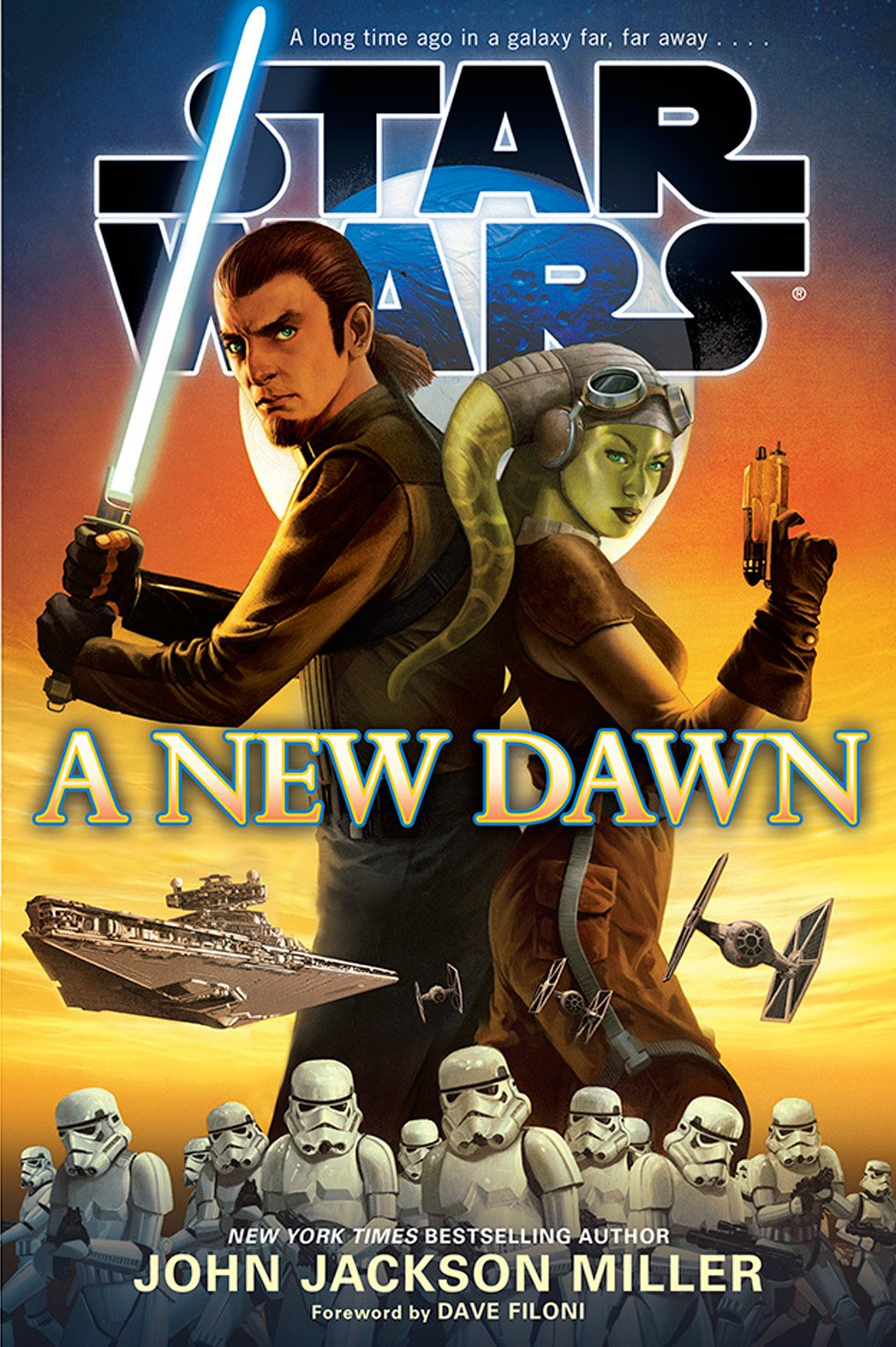
The first novel in the canon isn't perfect. Let's just address that up front. Some of the naming is lazy (the crazy derelict character is named Skelly, for example), though not as bad as Halle Burtoni. It attempts to tackle 21st century capitalistic idolatry and NSA government surveillance in really thinly veiled allegory, though not as thinly veiled as Halle Burtoni. Ultimately, these qualities pull one out of the novel, as it feels as though its trying to set the tone for "this era's" Star Wars, to be timely, when the best quality of Star Wars is its timelessness (even if some of the more terroristic tactics of the rebellion don't look as heroic in today's world). However, the sheer swagger of Kanan Jarrus from page one make this a serviceable adventure, with a story ultimately inconsequential but to advance further the career of Rae Sloane, a background character whose life seems to be working out really well in the Empire, and to serve as the origin of the pairing of Hera and Kanan, causing him to recognize there's a cause greater than himself. It lacks the depth of Lords of the Sith or the panache of Tarkin, but its a standard Star Wars adventure, feeling most akin to the Jedi Apprentice novels I devoured as a child, filled with fast paced action beats that make you hum the proper John Williams score as you thumb through them, and it serves as a good enough introduction to the two future rebels that you instantly want to spend more time with them. Yes, its a trifle without any real gravity, but its a fun trifle, and a quick read, so its worth taking a look.


"The End of History"

Originally appearing in Star Wars Insider 154, Alexander Freed takes us on our first real detour in the canon thus far, in a short story that features not a single character we've come to know, whose placement within the timeline is uncertain. Yet its endearing enough to pull in even the most skeptical of readers. It's an isolated a moving affair about an old man, a keeper of ancient knowledge, torn between helping a downed rebel pilot and preserving the stories he's been charged with. There's something almost Gaiman-esque about its sense of both mythology and our reverence towards it, and its the first short story that hasn't felt like a component of something larger, but rather ultimately satisfying on its own. Yes, I recognize tracking this down may prove difficult, but I highly recommend trying, as it captures that hopeful feeling that original trilogy is so known for embodying, so it acts as a bit of a taste of what's to come.


The HoloNet News Reports

Released as a series of eleven short videos in the build up to Rebels, these little broadcasts proved to be a delightful little insight into not only the day to day goings on of the Empire, but just how their propaganda machine works, daring the viewer to try and read between the lines and find the proof in the seemingly peaceful and universally beloved actions of the Imperial forces. Some, like the "Wookie Revolt Quelled on Kashyyk", are pretty easy to spot, but others like the talk of a "controversial" statue being removed makes one wonder "What are you hiding there?", not to mention the seemingly insignificant story of a famed Imperial pilot testing prototype TIE Fighters on Lothal proving to be an excellent punchline to one of the Rebels shorts down the line. Ultimately, these eleven 30-second clips might have been one of the best decisions the powers that be made in order to tell the story of the rise of the Empire, placing the viewer directly in the role of an Imperial subject and crafting brief flickers that greatly expand the world of Star Wars thus far. They're absolutely worth your time, and have all been compiled here.


Servants of the Empire: Edge of the Galaxy

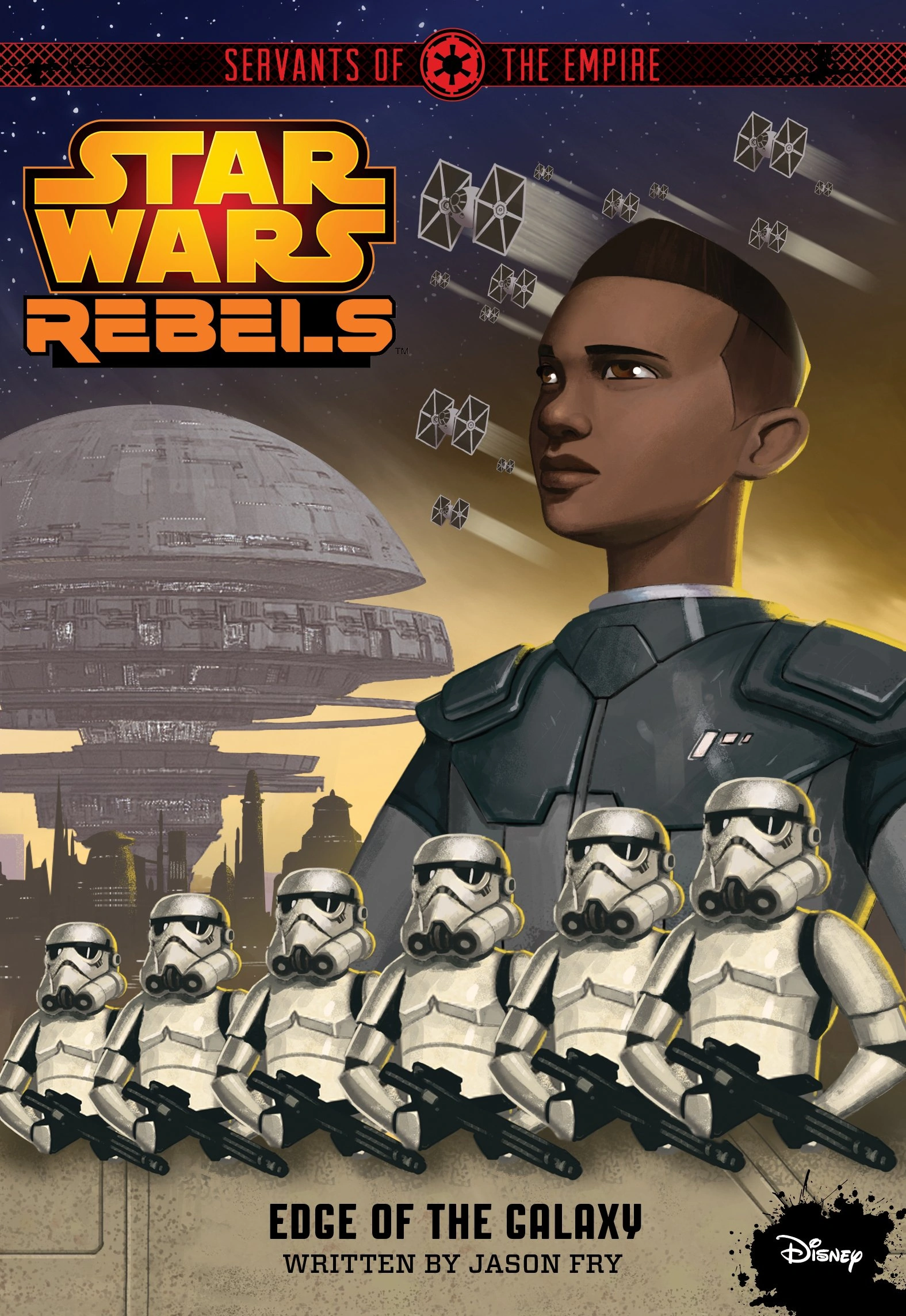
I'm going to be honest, I didn't have any expectations for the Servants of the Empire series. I was reluctant to even pick up this first volume from my library, as I felt it wouldn't be worth the judgmental gaze of the employees (as a 25 year old man, only a geriatric would qualify me as a "Young Adult", the novel's target audience). Yet, for you, dear reader, as well as my compulsion to be a completionist, I bit the proverbial bullet, and we astonished to find that Jason Fry had composed a truly engaging novel. Aside from being our first real portrait of the life of an Imperial, as well as the conflict that comes from discovering the Empire is not the benevolent group you'd believed it to be (perhaps forecasting what Finn will be going through in Force Awakens, though I'm probably wrong and will look foolish in two months time for even suggesting it), Servants of the Empire tells an Ender's Game-esque tale of intrigue and Imperial bureaucracy. Admittedly, after one 150 page book, I feel like I know as much about grab-ball as I did after 8 books about Quidditch (yes, 8. There was a whole Quidditch manual), and the numerous sport sequences, while I see their narrative necessity to a degree, do slow down the pacing. Even so, its simplistic writing makes for a very quick read, and there's a hefty amount of plot that thoroughly fleshes out both life under Imperial rule and the specific circumstances of life on Lothal. As the first of a four part series, the rest of which occurs throughout the Rebels timeline (to hopefully be addressed after the Rebels Season 1 article next week), Servants of the Empire: Edge of the Galaxy leaves you on a hell of a cliffhanger, and manages to leave even adult readers wanting me. It's a shockingly good and swift read, and definitely worth a shot if you're willing to claim you're picking it up for a nephew (just saying, that alibi works).


Ghost Raid

A browser-based game available for free on Disney's Rebels website, it's technically canon, and vaguely tells a new story, so for y'all, I gave it my time. In terms of placement, it's listed on Wookiepedia's remarkably thorough timeline as preceding the Rebels shorts, but its clear those occur during the events of the game, as it concludes on Lothal, with us presumably participating in the event Ezra witnesses in the final short. 

Anyway, the game itself is extremely simplistic, with nothing changing between levels beyond backdrop and the occasional design of an enemy. Through a combination of mouse-click activated blaster shots and space bar deployed bombs, you pilot the Ghost (Hera's ship, first introduced in A New Dawn) as it makes supply runs, downing Imperial cruisers while fending off TIE Fighters and other ships. The title cards between each level depict not only Hera and Kanan, but the astromech Chopper, Mandalorian Sabine Wren and the Lasat Garazeb Orrelios, without any explanation as to how the other three joined the crew. The only real "story" element we obtain from the game is the path that led the crew to Lothal, which is presumably canon, with a supply run on Ryloth and Christophsis, followed by trips to Kashyyk and Toydaria to assist the people there and gather more supplies, until ultimately arriving at Lothal and the crew concluding to stick around for a bit.

From a video game perspective (our first canonical video game, no less) it's not exactly Bioshock, but neither is it Superman 64. It's a simple little distraction, a slightly more demanding Candy Crush, if you will (not in terms of mechanics, but in terms of required attention), and not an awful way to kill 15 minutes. After all, after even a few clips of the Rebels cartoon, you're gonna be desperate to pilot the Ghost any way you can. You can play the game here, and though its not at all necessary, why not, right?


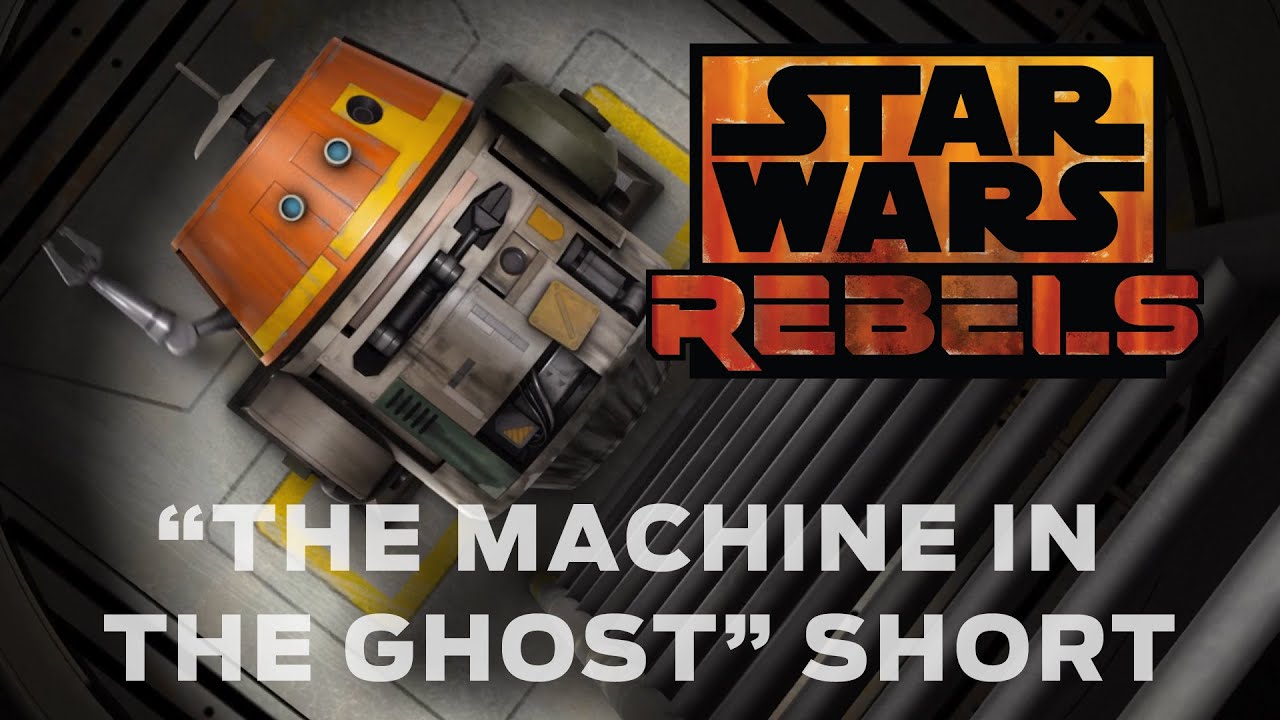
Rebels Short #1: The Machine in the Ghost

Here's our first taste of Rebels proper, our first look at the animation, our first peek at these characters in action, and from the first line of Chopper's indecipherable but vaguely "What the ****?" sounding dialogue, you've gotta be in. The action is engaging, the animation itself gorgeous and fluid, both cartoonish and still life-like, more organic than the Clone Wars' angular Stingray-like character designs. We get a taste of both Hera and Kanan's Beatrice and Benedict romantic banter, as well as a look at the disgruntled astromech who mans the ship, making for a brief but enjoyable taste of what's to come. You can find the short officially hosted here.


Rebels Short #2: Art Attack

Out of the four, this was easily my favorite short. It's light, fun and mildly unpredictable. It stays true to the spirit of classic Star Wars while also feeling like something we haven't seen before. As a Manadalorian whose look and attitude recall Bo Katan, Sabine's agility and affinity for color seem to suggest she'll make for an interesting component for the upcoming show, and her graffiti rebellion symbol, which looks like a cross between the rebel symbol we've all come to know from later installments and a Mockingjay, makes for an interesting component of the growing rebellion, like how we saw Coruscant's blue-armored guards slowly turn into the Imperial red-clothed guards. You can find the short officially hosted here.


Rebels Short #3: Entanglement

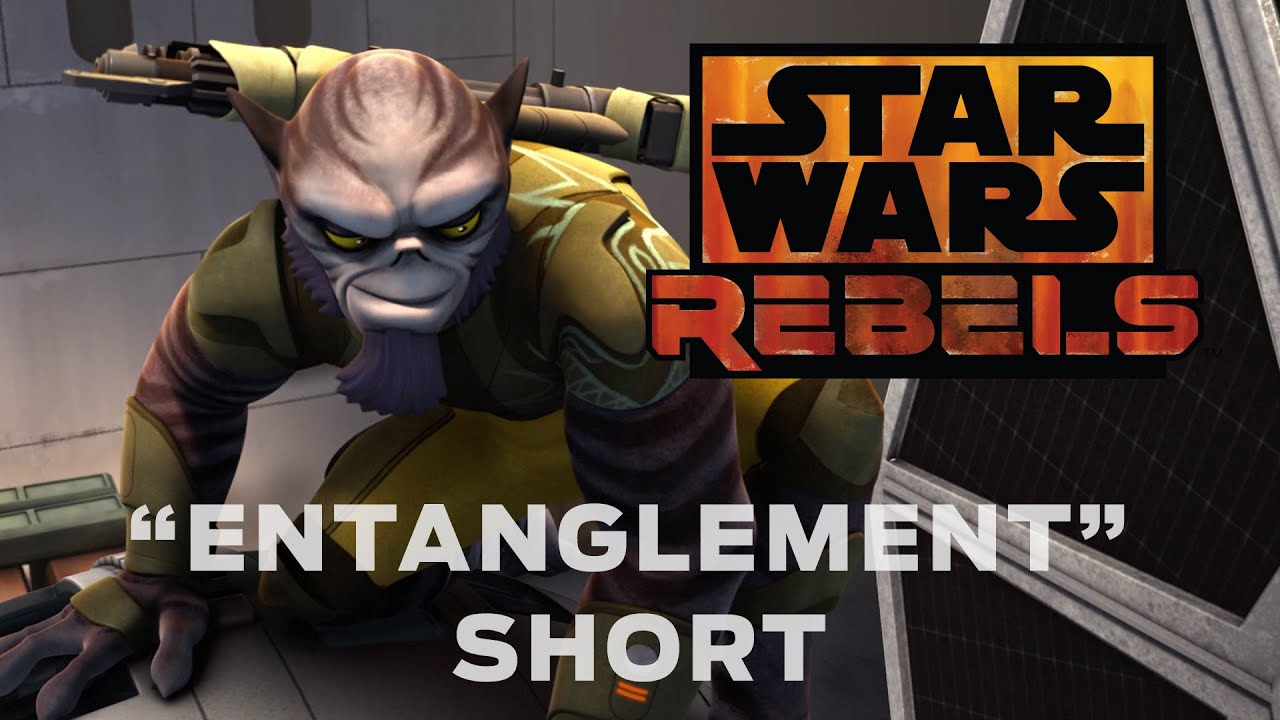
Though Entanglement follows every beat of the typical way to introduce a Star Wars character, from acrobatic conflict to sarcastic dialogue, there was seemingly no other way to properly introduce audiences to the big bruiser that is Garrazeb Orrelios, better known as Zeb. It's an enjoyable little piece, and its nice seeing that broad daylight action doesn't make the animation look any less fluid or diminish its quality in the way early Clone Wars episodes could occasionally suffer. You can find the short officially hosted here.


Ezra's Gamble

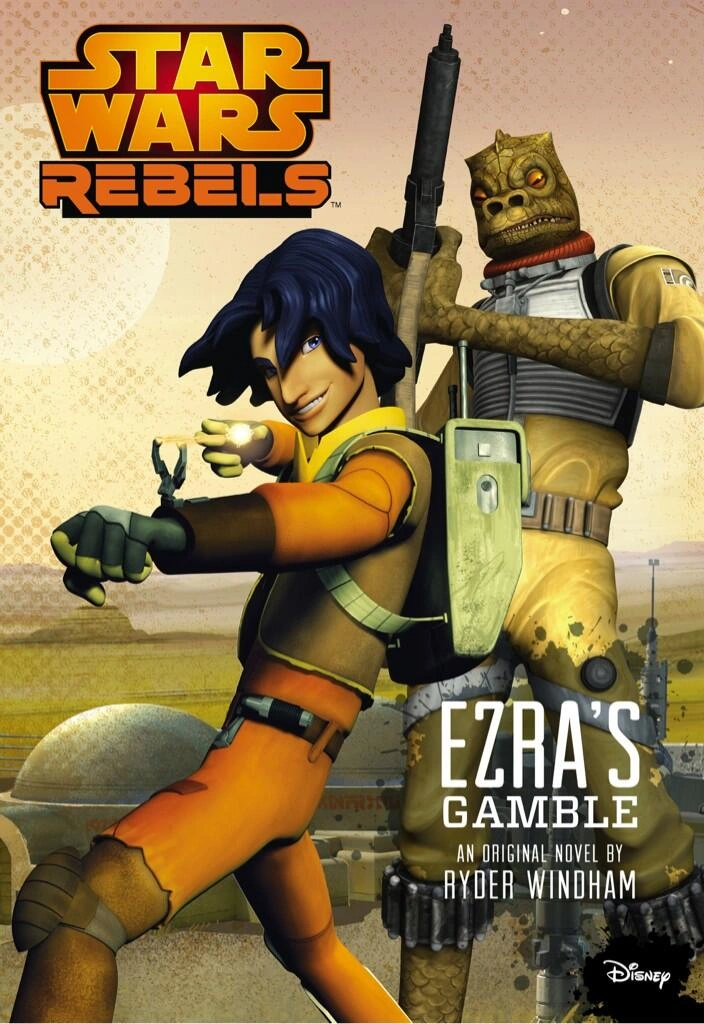
I'm not going to sit here and criticize a kid's book as though I were Harold Bloom dissecting Moliere, but where Servants of the Empire showed you could craft a unique and enjoyable work for all within the confines of the genre, Ezra's Gamble is much more standard children's book fare, complete with obvious twists, repetitive vocabulary and syntax, and simplistic characters (even for a universe full of archetypes). We're introduced to Ezra Bridger, who for the sake of simplicity we'll just describe as Aladdin in space, who winds up working in tandem with bounty hunter Bossk (who he refers to as Mr. Bossk, which gets grating pretty quick) to elude a nefarious Imperial, targeting him Bossk with mysterious motives. There's no MacGuffins in this work, so from the earliest introduction of a gladiator fight Ezra's selling tickets for on the behalf of a mysterious Commissioner, you know where we're headed, and we do eventually get there, without any sort of character development short of Ezra admiring the Ghost as it takes down a TIE Fighter he raids in the epilogue. Its not a chore to get through, and given its simplicity and page length, it takes an hour tops to finish. If you have a child who likes the Rebels series, this is a nice little bit of background on Ezra, divided into 10 brief chapters to make for easy bed-time reading. As an adult, its hardly worth a glance, save for completionists, but considering that's not at all who it was meant for, it can hardly be faulted for that.


Rebels Short #4: Property of Ezra Bridger

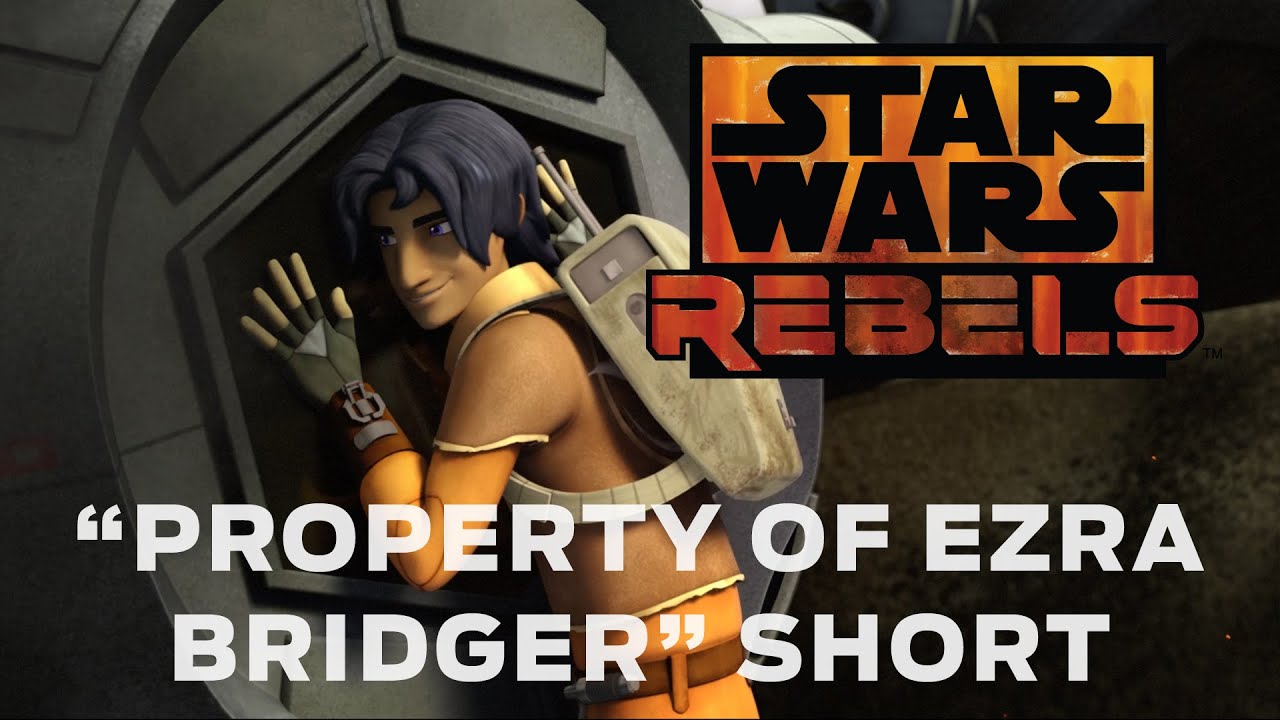
In a weird choice on someone's part, Property of Ezra Bridger doesn't pick up where Ezra's Gamble left off, but rather fully animates the final sequence of the book, with the dialogue and actions exactly the same as they appeared in Ryder Wyndham's work (though admittedly the events are much more fun than the book made it sound). The book was released a month prior to the short, but assuming the short was in production before the book given how long animation of this quality takes, its tough to say who actually copied who. Had the novel ended with the TIE Fighter being downed, and the short simply picked up from there, it would have made for a more fluid timeline, but even without, it's certainly interesting to see Ezra whistling through the fields of wheat (astoundingly detailed wheat), and knowing he'd just hours prior fended off stormtroopers on a speeder bike and stood in the center of an underground gladiator arena. You can find the short officially hosted here.


Well, that's it for the pre-Rebels work. Check in next week, when we'll be discussing the first season of Star Wars Rebels, and then from every week thereon out, its the original trilogy (peppered with mid-week bridge posts of the remainder of the canon, if at all possible. I am only human, guys). 

Friday, November 6, 2015

Star Wars Episode III: Revenge of the Sith

First time here? Get caught up with the mission statementEpisode IEpisode IIthe Clone Wars moviethe first season of the showthe secondthe thirdthe fourththe fifth, the sixth and the Clone Wars Legacy.


The year is 2005. Future Star Wars director JJ. Abrams gets an Emmy for Lost, everybody was plugging plastic guitars into their PS2s to master "Ace of Spades", and a strange little video site called Youtube came into being; sci-fi and fantasy dominated the box office, with now classic films like Harry Potter and the Goblet of Fire and Batman Begins, and others that haven't...really aged...all that well (I'm looking at you Spielberg's War of the Worlds and Peter Jackson's King Kong. And I'm the only person that's looked at either of you in years); and I was 14 years old. I really should just stop there, honestly. 14 is the age where looking back stops being whimsical nostalgia and just starts being constant cringing. Nonetheless, this was a big year, my friends and I all knew. This was the end of the Star Wars saga. The final film. Never to be another (so we thought). Finality was in the wind, and that wind swept up our hype like a plastic bag on the breeze. The other films be damned, they said (I didn't because you have to remember, at that point I swore by Episode I and apathetically recalled Episode II, so I liked the vitriol others so gleefully had). We were gonna embrace this. I lined up outside my local Toys R Us for the "final" midnight madness, I met up with my friends after school in the park outside and dueled with the cheapest plastic lightsabers available (which would break very easily, creating jagged edges and very real wounds, in perhaps the lamest way to get scars). It was all anyone could talk about, and when the big night came, I was lined up outside my local multiplex in full Luke on Dagobah costume (complete with plush Yoda in backpack) awaiting the midnight screening.

When the credits rolled, I remember my row of friends all freaking out, shouting and cheering. My father turned and asked me what I thought, and with a certain "Noooooooooo" still swirling around in my head, I gave an opinion I'd maintained until this rewatch: "What a piece of s**t". I'd never looked back since, never viewed it in its entirety again, avoided it on cable. Loathed it like I'd loathed no other for what I saw as such squandered potential. Of course, even then there were moments I remembered fondly, mainly the performances of Ewan McGregor and Ian McDiarmid, but those couldn't outweigh atrocities like "From my point of view, the Jedi are evil!" I get that it's meant to mirror Obi-Wan's later "from a certain point of view", but come on, it's like McGregor was going to respond with "Well, I hope you should reconsider. I have some flowcharts here..." So after 7 weeks without a prequel, spent taking in some inconsistent but entertaining stories, I was dreading taking on the only Star Wars film I ever hated.

Well, enough forbidding and loathing, let's talk about Episode III: Revenge of the Sith, shall we?


Obviously, from here on out it's gonna get pretty spoiler-heavy if you haven't seen Revenge of the Sith (or indeed any of the previous installments), so if such a thing worries you, now may be the time to turn back.

Well, I'm getting ready for a steep decline in readership moving forward for what I am about to say, but I need to say it: this is a good movie. It's not without its faults, but its a damn fine piece of entertainment all the same, and actually contains not only some of the best acting of the prequels, but one of my favorite moments of the franchise. It honestly makes me sad George didn't make a film after this, as you really see him come into his own visually, shake off the cobwebs and create some delightful and engaging scenes. McGregor is at his best, McDiarmid nails it even when hamming it up, and even the much maligned Christensen, while not as good as Matt Lanter from Clone Wars, does his damnedest with the material he's given, and hey, at least he's not as bad as that kid from Episode I, what vacuous black hole who stole all joy and momentum from any scene he was in. Nothing could be as bad as that kid...or so I thought.

Yes, there is one truly dreadful part of Revenge of the Sith, and while you can forgive Jake Lloyd for his age and simple lack of talent, this problem can only be blamed on someone's lack of giving a single solitary ****. And I mean that, I have several notes from across the film's runtime just commenting on how little of a s**t this person could be bothered to give, and those who've seen the film and aren't part of the anti-Hayden dog pile know exactly who I mean.


Look, I loved Garden State. I think she acted the hell out of Leon, the Professional, I think she nailed V For Vendetta, and I think she damn well deserved that Oscar for Black Swan. Hell, I thought she was even fine in the first two prequel films. But here it;s clear she checked out well before the cameras started rolling. Go out, rent Closer, rent My Blueberry Nights. We know she can do better than this when she cares, and perhaps some of the blame can be put on George, but at least he's trying. The same for Christensen. As rough as some of that dialogue gets, there's at least some sense of purpose, some desire to do god and failing. At 14, "phoning it in" wasn't really a phrase that had entered into my critical arsenal, but I'd heard it so often rightfully applied to Portman's performance in this film that its now become the benchmark for me, the standard by which all others are compared before I apply the label to them. However, for the first 20 minutes, before Portman takes the wind out of the sails, we're given a film that's not only good, it's exceptional.


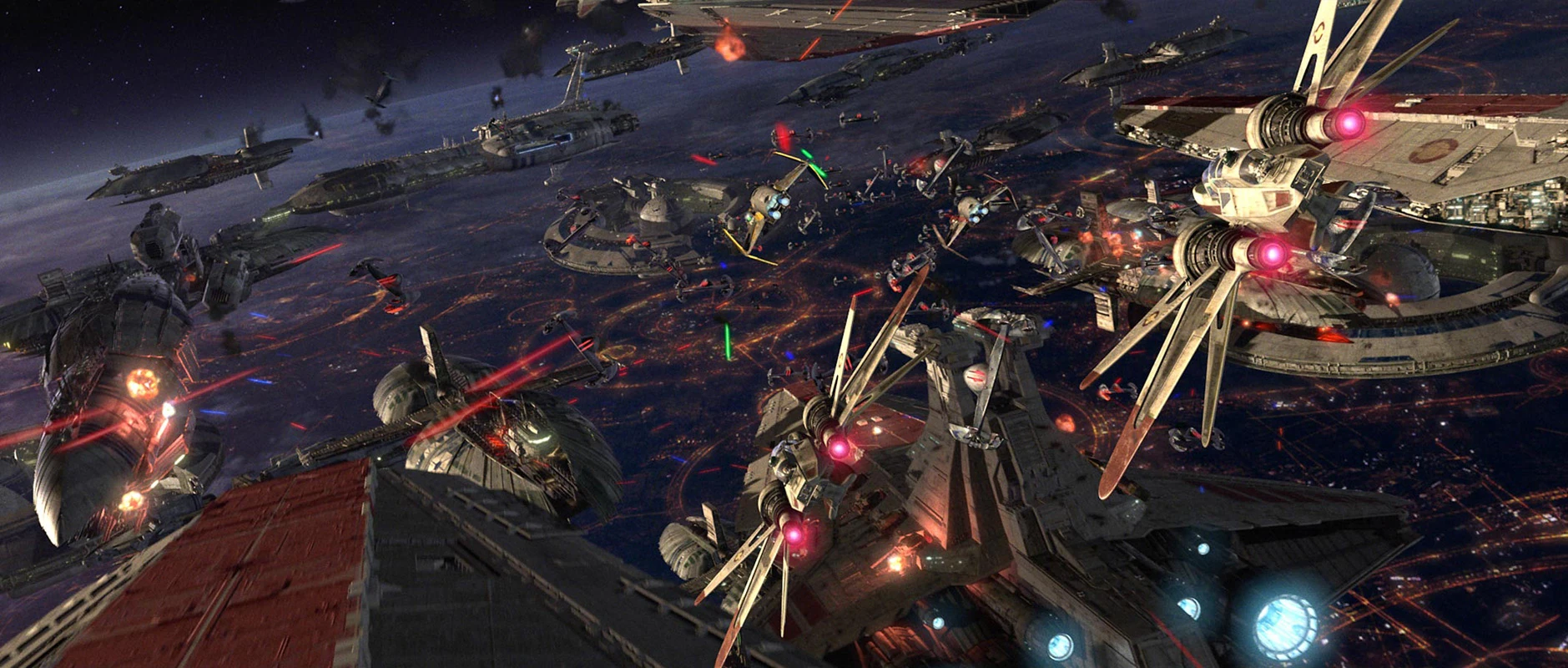
Following an opening scroll explaining that Palpatine was kidnapped by General Grievous (which makes me desperately wish that was how they wrapped up the canon Clone Wars series, the way the original non-canon Star Wars: Clone Wars did), we're treated to a thrilling space battle, with tracking shots, chaotic choreography, great banter between Anakin and Obi-Wan on their way to rescue the Chancellor. They fend off buzzdroids, they dodge vulture droid missiles, their ships skid across the docking bay of Grievous' vessel, with the Jedi leaping out and brilliantly slaying the awaiting droid army. It's exciting, it's enthralling, and when we're introduced to the gorgeously designed General Grievous, the film immediately hooks you with the kind of fanciful space operatics that so came to define the original trilogy, reminiscent of the Flash Gordon stories which inspired it. And inspired is the right word here, since this is the first time in a while Lucas feels inspired. Everything comes together here brilliantly, even the shot choices and the color seem the work of a passionate artist. When the duo finally find Palpatine, and Count Dooku (a sorely underused but excellent Christopher Lee) arrives with a swelling score, you can't help but get excited as he battles the Jedi, eventually knocking Obi-Wan unconscious, leaving Anakin to fight him alone. After being chided, we see Anakin feed into his hate, eventually besting Dooku and trapping his head between two saber blades (Dooku's and his own). Palatine, seeing his opportunity, implores Anakin to kill Dooku, but casually. Almost off-handed, regal. He knows Anakin is susceptible to the dark side, he's seen it, all he needs is the smallest push; and it works. It's a great scene and the subsequent escape scene, while a little long, as exciting and full of a fresh energy that lasts right up until they land back on Corsucant.

As they leave the ship, Obi-Wan seems surprisingly cool with Anakin killing Dooku (I know he himself killed Darth Maul, but still, shouldn't we be worried a little, since Anakin's had a lot of anger issues throughout the Clone Wars?), and they debate just how many times Anakin's saved him, including an incident on Cato Neimoidia, which of the two episodes that occurred on the planet in Clone Wars, we never see. Anakin has a brief liaison with his secret wife (who's basically reduced to a crying mess in this film, as opposed to the confident, take no s**t woman of the first two films and Clone Wars). She tells him she's pregnant, and honestly, just skip to the 1:24 mark below.


Their faces are perfect. The acting is sharp, and honest. When she reveals her pregnancy, look at Anakin, he's scared, happy, angry. He doesn't know what to feel, and she searches his face to see what not just that moment but their entire future holds. We've got six films, two TV series and an ever growing number of novels and comics, all telling fairy tales, archetypes over complex characters, but here is the closest we've ever come in any of them to honest humanity, to raw human emotion. Its a brilliant scene, and for one shining moment in this film, the two of them are believable. Sadly, it never reaches this height again, and some may attribute it to the proverbial stopped clock being right twice, but I think if nothing else this scene shows what a great film was lurking beneath all the missteps and miscasting.

Anakin becomes plagues with dreams of Padme dying in childbirth (which is the closest we get to payoff on his mom's "he can see things before they happen" stuff from Episode I), which he explains to her in a scene she's in but barely present, half-assedly delivering some of the worst dialogue in the series. Basically, from here on out, she's check out, and the film's momentum hits a snag any time we see her. Hayden handles the clunky script with a sense of purpose, to his credit, but its not enough to salvage these painful moments.

Meanwhile, Palpatine has received further emergency powers, allowing him control of the Jedi Order, and he appoints Anakin as his representative to the Jedi Council. However, while the Council concedes to allow Anakin in, they deny him the title of Master, and Christensen and Sam Jackson have a great bit of tension as Anakin petulantly disputes the decision, cut off by Windu's forceful command of "Take a seat, young Skywalker". Obi-Wan takes Anakin aside afterwards and asks him to spy on Palpatine on behalf of the council, which Anakin reluctantly agrees to (the dialogue and acting in this scene are actually exceptional). Obi-Wan departs for Utapau to hunt down General Grievous and while Yoda leaves for the Wookie planet of Kashyyk for...reasons.

Ok, there's a vague necessity to having Obi-Wan on Utapau, since Grievous needs to be dealt with (the other Separatist leaders have been moved to Mustafa on Darth Sidious' command), but Yoda's arrival on Kashyyk is utterly pointless beyond just not anting Yoda there at the temple when Anakin goes on his rampage (and a painfully forced fan-service cameo from Chewbacca, which adds a really weird layer to the next trilogy, since Han doesn't believe in the Force, yet his long-time partner straight up fought alongside a Jedi). While its nice seeing the clone trooper armor essentially become speeder bike trooper attire on Kashyyk, and there's some thrills on Utapau, its hard not to feel as though everything from Grievous' wheel-bike to Obi-Wan's weird lizard mount were all specifically and meticulously crafted to sell toys, to the detriment of a scene with too many set-pieces and not enough purpose (or in the case of Kashyyk, no purpose at all). Eventually, Obi-Wan manages to kill Grievous with a few blaster shots to the chest, which is a surprisingly simple and effective kill, considering how immortal Grievous seemed in Clone Wars. I mean, why didn't anybody try that before?

In condensing the painfully spaced out Utapau and Kashyyk sequences, however, I skipped over the best scene in the entire film. Everything from the lighting, the score, the dialogue, the acting. It's flawless, and is easily one of my favorite scenes in the entire franchise.


Palpatine, the master manipulator, convinces Anakin of a plot by the Jedi to overthrow the Republic, but then preys on Anakin's vulnerability, his fear of losing those he loves. But he doesn't do it directly. He doesn't say "Join the dark side, and I will teach you...". He tells him a story, spins a myth, and in doing so expands the Star Wars mythology, both in the literal and figurative sense. The scene contains an immense and exquisite subtlety, an artistry of writing like we've never seen from Lucas before, and for me it eclipses even the best action sequences in the film, standing out at the finest thing about the entire prequel trilogy (besides perhaps the very existence of "Duel of the Fates").

Later, when Anakin goes to Palpatine's office to tell him of the discovery of General Grievous, Palpatine much more bluntly (and with sloppier writing) reveals himself to be the Sith Lord, and Anakin fights the temptation to kill him, of once behaving in line with the Jedi principles, and goes to report Palpatine to the Council. Meanwhile, news of Grievous' defeat has reached Windu, who is determined to ensure Palpatine relinquish his emergency powers under threat of arrest. Anakin arrives in time to inform Windu of Palpatine's secret, and Windu insist Anakin stay behind lest his clouded judgement prevent the from arresting him. However, tortured by the idea that without Palpatine, Padme may die, he soon follows.

We're treated to a swift but fantastic fight when the Jedi arrive at Palpatine's office, with the Sith Lord quickly executing every Jedi besides Windu, who holds his own. Anakin arrives just as Windu has Palpatine cornered and is using his lightsaber to deflect Palpatine's own force lighting back at him, giving him that famous disfigurement. Wind is ready to kill Palpatine, who dramatically pleads for his life (McDiarmid gets really theatrical and hams it up here, but still pulls it off in my book). Anakin, once again behaving in line with the true way of the Jedi, demands that Palpatine stand trial, but Windu's rage has taken over, and he claims Palpatine is too dangerous to live. Ready to strike the death blow, Windu is stopped by Skywalker cutting off his hand, before Palpatine uses his force lightning to launch Windu from the window, killing him (while inexplicably screaming "unlimited power"). Swiftly, identifying all Jedi as enemy of the Republic, with Anakin finally in agreement, he orders all the clones to "execute Order 66", which some of you may recall from the final Fives arc of Clone Wars as being the code to deactivate the inhibitor chip in the clone brains, causing them to kill all of the Jedi. Taking Anakin in as his new Sith apprentice, and renames him, dubbing him Darth Vader.


As a younger man, it always troubled me, that name. Of course, it strikes fear into everyone who grew up with the original trilogy's hearts, the Voldemort before their was a Voldemort in terms of names. But I always found it silly that Lucas gave all the other names such purpose. Sure, "vader" is the Dutch word for father, and Lucas was cleverly telegraphing The Empire Strikes Back's big twist (one of the most famous in all of cinema) in the first film, but instead of imbuing the other Sith with seemingly meaningless names, he goes out of his way to give them dark connotations. Darth Tyrannous, Darth Sidious, Darth Plagueis, Darth Maul; Tyranny, Insidious, Plague...and Maul. Why do they all get such menacing names, yet Anakin gets "Vader"? But upon this viewing, I felt like I understood, even if it took a leap of logic. If one assumes that as English is to Galactic Basic, other global languages have a parallel within the Star Wars universe, than Vader could well be the word for father, or similar sounding to it, in one of those languages, and that could be why he earned the name; essentially, it could be that Sith earn their new name based on what initially turned them to the dark side. For example, Maul was a Dathomir male, and we've seen that once the ancient magics are within them, they become animalistic, vicious. It doesn't take much of a stretch to imagine the type of massacre we see Savage Oppress exhibit to earn the admiration of Dooku in Clone Wars is similar to what feats of skill Maul demonstrated to Palpatine, and so it is his rage, his animal fury that brought him to the Sith, making Maul a fitting name. Similarly, the rich, aristocratic Dooku had aspirations to use his dark power to rule, to be a leader, to oppress the lower classes from his palaces, so his tyrannical aspirations bringing him to the dark ways earned him his title. From what we've seen of Palpatine's machinations, and what we learn in brief flickers about his past in the later canon novels (I know, I know, I'm jumping the gun a little to make my point), he's power hungry in a different way. He's Machiavellian, he's subtle, he's the snake in the grass quietly pulling strings. He's by definition insidious, and therefor earned his title thusly. It stands to reason that given Padme's death is the impetus for Anakin's desperate need for the powers of the dark side, rather than a need for power or glory, his Sith name wouldn't be one of overthrow or fear, but one of paternity.

Vader leads an assault on the Jedi temple in a truly gorgeous and all too brief sequence, with the utterly chilling scene of the children pleading with Skywalker for help before he reveals his saber blade. Meanwhile, Lucas gives us his version of the famous "Godfather Christening" as we get a montage of Jedi being mercilessly slaughtered by clone troopers, with only Obi-Wan and Yoda seemingly escaping with their lives (there may be a certain Padawan who survived too, but we won't get to him until our next installment). Bail Organa witnesses the Temple massacre firsthand, and sets out to find surviving Jedi. Obi-Wan, Organa and Yoda convene, and agree to recalibrate the emergency beacon that was calling all Jedi back to the temple to instead warn them to stay away. Vader returns to Padme, and tells her the Jedi plan to overthrow the Republic, and that he must go to Mustafa to end the war, and its right around here that the film loses all momentum.


Yes, we get one final great sequence of Vader on Mustafar, trapping all of the Separatists by shutting the doors with the Force and slaughtering them as they plead for their lives, but we then waste too much time watching the Jedi do a whodunnit over the corpses of dead Jedi children, trying to make suspenseful a reveal we already knew as we watched the massacre happen ourselves. The Jedi recalibrate the message while Palpatine calls an emergency Senate meeting to speak about the Jedi's attempted rebellion, and to declare the Republic the new Galactic Empire, which is a pretty good scene that could have been capped off brilliantly, as it has one of the best written lines in the prequels: "So this is how liberty dies...with thunderous applause", which is both topical and universal, political and proverbial, yet its unfortunately a line being delivered by Portman, who practically tosses it off while waiting for her paycheck.

There's a great moment where Obi-Wan pleads with Yoda to go after Sidious himself so that he wouldn't have to kill his former apprentice, but Yoda tells him he's not powerful enough, and the two agree to their separate fates. Obi-Wan seeks out Padme and tells her of her husband's crimes (while figuring out Anakin fathered her unborn children), and while she refuses to reveal where Anakin went, Obi-Wan knows she'll go to him, and stows away on her ship. She goes to Mustafar, and Vader, sensing Obi-Wan's presence, lashes out at her, ultimately force-choking her near-death before being interrupted by Kenobi, who for some reason stands atop the ship's ramp with his hands on his hips like 1930's Robin. Meanwhile, Yoda has tracked down Darth Sidious to his office, and after dispatching his Imperial guards with the wave of his hand like the tiny badass he is, and an awkward shot were the actor playing Mas Amedda seems to glance at a boom or something while Palpatine is talking, the classic moment occurs.

Lets face it, if you remember one part of Revenge of the Sith, this is the part you remember. The "dual duel" as it were, where Yoda and Sidious engage in over the top acrobatics through the Senate Hall while Vader and Obi-Wan battle it out amongst the magma of Mustafar. Everybody has one they prefer over the other (I prefer the Mustafar fight), but these scenes are as iconic as anything gets out of the prequels outside of Darth Maul's lightsaber, and for good reason: They're well shot, well-choreographed, and short of some painfully laughable dialogue (re: "From my point of view..."), they're utterly captivating.


Anybody who can watch the above 14 minutes and claim this movie doesn't at least have some great moments is just being an insufferable Amblin kid. Admittedly, these fights are the last high note of the film, and it screeches to a halt of "Holy s**t how much longer does this have?" after that, but damn if it isn't a fun ride getting there. Ultimately, Vader foolishly leaps toward Obi-Wan, who has the high ground (which he awkwardly states), and Obi-Wan somehow manages to cut off all three of Vader's remaining limbs (somebody please chime in in the comments or message me to explain how in the hell that could possibly work). Here, you gotta give these two credit, especially McGregor: these guys act the hell out of this scene. McGregor seems on the verge of actual tears as Hayden devolves into a creature of pure rage. It's a great scene, and Vader burning alive while Obi-Wan watches is so brutal. Quite frankly, if it weren't for the bit of pipe-laying involving the metal suit and the twins being necessary, that movie really could have stopped with Obi-Wan walking away, and it would have ended brilliantly.

But that bit of pipe-laying, setting up the original films, is necessary, that work needs to be done. However, it doesn't need to be done at a snail's pace. The much maligned birth scene deserves all of the malign. Portman is at her worst here, and it doesn't help that "dying of a broken heart" is a direction not even Meryl Streep could do anything with. That said, Padme's flicker of pain and middle-school drama class tears before immediately naming each child as sonar they're out of her is just awkward and uncomfortable, somehow being the slowest scene in history to ever feel rushed. Yes, it's great watching Vader be worked on by droids (the lighting in that sequence is stellar, and the truly inspired idea to have all of those droids move statically, almost stop-motion-esque gives the scene a great tone), but that's soon undone by the quite-frankly nauseating Frankstein pseudo-homage of Vader breaking free of his bindings to atrociously yell "Noooooooooooo!" after Palpatine tells him he killed Padme (which makes way more sense than a broken ****ing heart anyway). We're then dragged through a tedious Jedi custody battle as Organa eventually agrees to take in Leia, and Yoda decides Luke should be with his family on Tatooine because...reasons? I mean, he says the child should be with his family, but a) No, he shouldn't since Vader could find him, and b) if he should be with his family, shouldn't that mean Leia too? You're already taking one of his family away, and basically keeping her away from all her family. Why doesn't Leia need to be with her family, huh, Yoda? What kinda sexist s**t is that? Yoda also tells Obi-Wan that he shall stay on Tatooine and confer with his old master Qui-Gon to learn the ways of living after death, which is a nice piece of dialogue not just because it partly explains why Obi-Wan stayed, but also validates the final arc of Clone Wars Season 6, giving it more of a connection to the saga as a whole.

So while Vader and Palpatine watch over the construction of the Death Star, and Senator Organa asks to have C-3PO's mind wiped (but not R2) because...reasons, Obi-Wan delivers Luke to Beru on Tatooine, and Owen stands atop a familiar piece of homestead, gazing out at a familiar set of twin suns, aaaaaaaaaaaand credits wipe!


So there you have it. The prequel trilogy is concluded, the little slave boy from Tatooine is now the most feared villain in the galaxy, the Republic is now the Empire, and I'm now itching to get to the next set of films (though two more weeks to go before that). Admittedly, Revenge of the Sith isn't a perfect film, but its also not nearly as awful as people make it out to be. There's some cool action, some great performances, a good amount of world building (Quinlan Vos is even referenced by name), and certain moments like seeing the Imperials all in their uniforms give jolts and chills. It's not expertly crafted, but there are some truly inspired moments that show Lucas returning to his THX-1138 and American Graffiti form, which makes it a genuine shame we all sorta abused him out of the director's chair (though I think his heart was never really in it as it is for producing). It's easily the best of the prequels, and I'll be curious to see where it compares to, say, Return of the Jedi which doesn't really have the love the other two do outside of the fawning Amblin generation. That said, in response to is it worth watching, the answer is absolutely yes. It's genuinely a good film, mostly enjoyable, and whose faults are scene specific and mostly singular (but she's so good in other things), so as long as you have your skip button ready, the film is well worth a rewatch. As for the whole of the prequel trilogy? Even though I'd said Phantom Menace itself isn't worth your time, and I stand by it, the whole prequel trilogy is. There's enough good in these films to outweigh the bad, especially with Clone Wars existing to fill in some of the faults in the films (like explaining why the clones act on Order 66, how Qui-Gon can still be around but never appears as a force ghost, etc.). If someone offers you the chance to watch the full prequel trilogy, don't pass it up just because of Jar Jar Binks and some bad romance scenes. Overall, these films don't deserve the vitriol that's hurled at them, and indeed deserves praise for some portions. Combined with Clone Wars, its a pretty good saga so far, and the stage is set for the epic battle of good vs. evil.

We're scheduled to talk about A New Dawn next week, but I'm going to try and broaden it out and tackle everything in the canon between Revenge of the Sith and Rebels, which means three novels, some comics, some short films...its a lot of stuff, basically. I'll keep it as spoiler-free as possible, akin to how I did the Clone Wars Legacy post, as opposed to digging in deep with A New Dawn as I'd originally intended. After that, it's one season of Rebels, and then we're on to the original trilogy. We're almost at the end now, guys, but we've got miles to go before we sleep, and I look forward to hearing from you every step of the way.

Tuesday, November 3, 2015

Bonus Entry: Star Wars The Clone Wars Legacy

First time here? Get caught up with the mission statementEpisode IEpisode IIthe Clone Wars moviethe first season of the showthe secondthe thirdthe fourththe fifth and the sixth.


Hey guys, just a quick little post between posts, unscheduled, to talk about The Clone Wars Legacy. Now, this stuff doesn't much get talked about, since anything Clone Wars created post-Disney acquisition got sorta swept under the rug once it took place and they decided to focus on stories after the prequels and original trilogy (namely Rebels and Episode VII). Unfortunately, the production team had already written scripts and done early test work on Season 6 and even Season 7. The finished a short order for Season 6, as you know (we covered that in the last column), and were left with two unfinished arcs and two that were only scripted. Rather than let these fall forever in some archive somewhere to never be seen, Lucasfilm decided to create something called the Clone Wars Legacy, a subsection of the Clone Wars franchise that existed to tell these stories in whatever form they could, from hosting video on StarWars.com to adapting the scripts to comic book or novel form. So with so many unfinished stories of the Star Wars The Clone Wars universe available for us to experience (all canon), it's only right to wonder: were all these stories that bad they gave the go-ahead to finishing Jar Jar's love story?


The answer is no, emphatically no. Well, mostly emphatically no. Look, how about we just do a little blip about each, as spoiler free as possible, to let you know what's worth checking out:


Nothing like static, lifeless, PS2 graphics to move a story along, huh? Look, you can't fault the visuals for something that are essentially animatics, not intended for public consumption. The episodes A Death on Utapau, In Search of the Crystal, Crystal Crisis and The Big Bang must be judged on their writing, not their look. That sad, the stunted rough draft does hint at what could have been some beautiful visuals, and there's some really fun banter between Anakin and Obi-Wan, reminiscent of what we get in Attack of the Clones during the big Coruscant chase. The plot is honestly a little weak, but this is really a character arc, with some hilarious moments (Anakin and Obi-Wan bickering about how to properly use the force and their lightsaber at the same time) as well as some moving ones (Anakin suggesting they call Ahsoka before remembering her departure from the order, and Obi-Wan trying to comfort him). Typical of Clone Wars, the arc runs on about an episode too long, but over all it's a shame this hit the cutting room floor over honestly any of the completed arcs for Season 6, if solely because this is perhaps Matt Lanter's finest moment in a series where he really just nails it every time. Is it worth the watch? Absolutely, and if you've got ~90 minutes to spare, you can check it out here.


The Bad Batch arc is in the same boat as the Utapau arc: It's overly long by an episode, hampered by its unfinished animation, yet this is perhaps the more frustrating of the two arcs in its fate in that the introduction of the so-called Bad Batch, a group of clones born deformed with specialized skills, called in for a special assignment, is fantastic. Their personalities are instantly engaging, their quirks, including a bombshell painting of Padme on the side of their ship (much to Anakin's chagrin), utterly delightful. You're also treated to a moment of ferocious brutality from Anakin where he comes as close as ever in the series to renouncing the Jedi order, and if there's one shame in the series it was that it never showed us the further progress of Anakin's descent into the Dark Side prior to Revenge of the Sith. Is it worth watching? Definitely, and you can check it out in the same place (and around the same amount of time) as the Crystal arc (which if you're too lazy to scroll up is here).


"Kindred Spirits" is a short story which appeared in Star Wars Insider Issue 159, and functioned as a prequel to the Christie Golden novel Dark Disciple. The novel was based on an eight episode arc intended for the seventh season of the series, but the preceding short is presumably an original story by Golden with follows the somewhat reformed Ventress in partnership with a pirate, battling her way out of a stand-off with a different pirate (and considering how few pirates the series had, you can guess who at least one of them is). It's an entertaining enough short story, peppered with elements that would go on to appear in the novel, and Ventress makes for a fun story in almost any scenario anyway, so the question of whether it's worth reading comes down to your particular fondness for the character. It's definitely not essential reading either way, but if you dig the character as much as I do, it's a fun little read. Otherwise, it's nothing to break your back trying to get ahold of now that the issue isn't in stores.


Holy crow, was this one tough to take. Now, this wasn't my first rodeo with a Star Wars novel, not even in terms of the new canon, but books like Tarkin and A New Dawn (which we'll be discussing in about two weeks time) were quick reads, done in a day or two. Dark Disciple became a chore fairly quick, and not because it's some Joycean novel of epic size or complexity. It just drops the ball with what should be an amazing premise. Asajj Ventress teaming up with Quinlan Vos to assassinate Count Dooku on the order of the Jedi Council, Ventress training voice and drawing him closer to the dark side, unwittingly playing him right into Dooku's grasp, this could have been amazing. However, its bogged down by an out of character love story for Ventress as she becomes almost a blushing schoolgirl for the cool-guy Jedi, who ultimately winds up the protagonist of the novel while Ventress gets further and further relegated to the sidelines as the book goes on. It's prose isn't abysmal, and doesn't rank so much beneath the other novels so much as its too dry to save this insufferably meandering plot. It gives some somewhat satisfying closure to Ventress' arc, but fails to stick the landing overall, and you lose interest well before that, slogging through it solely out of a sense of completion. But trust me, dear reader, I do this so you don't have to, and trust me: Just skip right past this. This isn't the kind of story you're looking for. Move along.


On the other hand, there's this. Darth Maul: Son of Dathomir, the four issue comic book series from Dark Horse Comics (the only Dark Horse comic still considered canon). This is a must read. Go out, rent it, read it, buy it. It's the first Clone Wars story in a long time with an acute sense of purpose and brevity, it does right by all the characters contained within, possesses a great sense of finality while still opening the storytellers up to new possibilities, and is ultimately the most exciting part of the entire Clone Wars Legacy (and form the quality of the writing, it's clear the crew behind it knew this too. 100% worth reading, and indeed re-reading. I intend to as soon as I'm done with this.

So that's it for the Clone Wars Legacy, mostly engaging with one swing-and-miss. Check out what you want from it, then feel free to chime in in the comments to let me know what you though. Or, you can just hang out and wait, because we're just days away from discussing the final installment of the infamous prequel trilogy, Star Wars Episode III: Revenge of the Sith, and you don't wanna miss that.